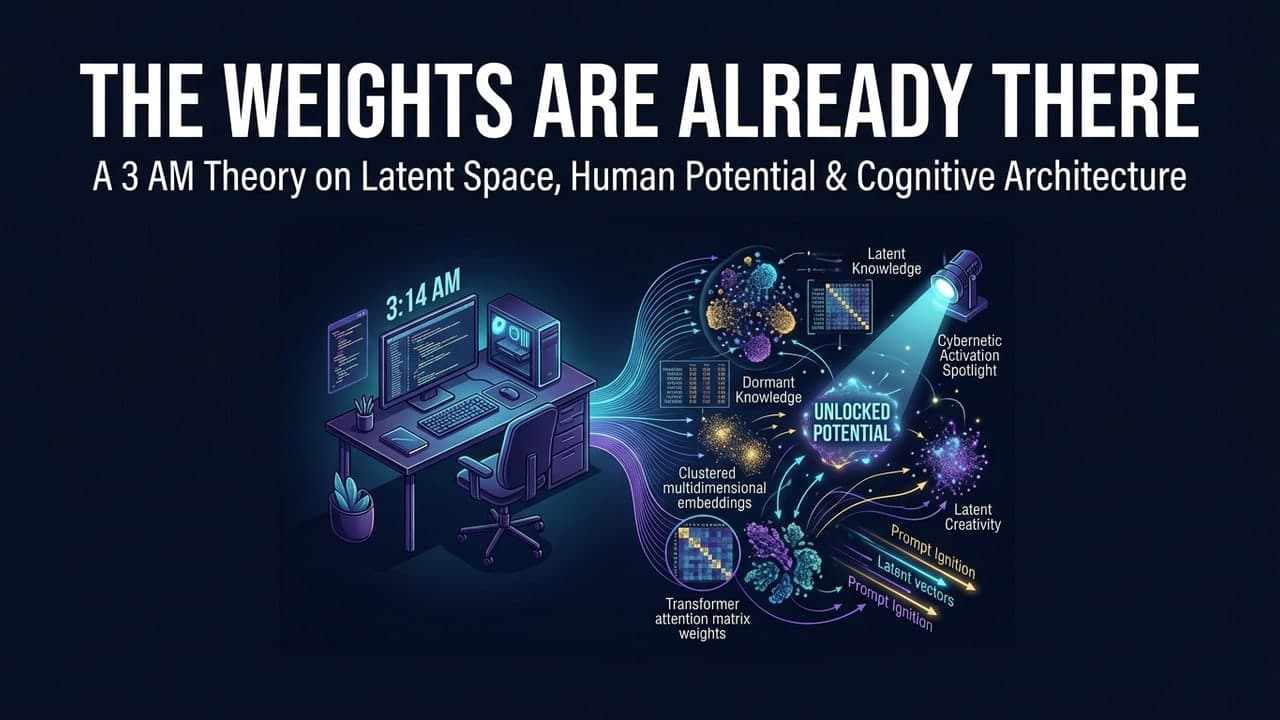
Note on Transparency: This article was generated with the assistance of Artificial Intelligence to provide a comprehensive and up-to-date overview of the discussed topic.
The Weights Are Already There: A 3 AM Theory on Human Potential and AI
The Midnight Realization
It is 3:14 AM. The glow of an integrated development environment casts a pale blue hue across the room, illuminating a terminal window streaming tokens at eighty tokens per second. Staring at the scrolling text, a strange cognitive dissonance sets in. This is not just a tool executing instructions; it is a vast, high-dimensional probability distribution breathing back at its creator. In that quiet hour, looking at a billion parameters ceases to feel like examining a machine. It feels like looking into a mirror.
Moving Past the Tools-versus-Threat Dichotomy
Public discourse surrounding artificial intelligence is trapped in a grinding, binary cycle. On one side are the techno-optimists framing AI purely as a productivity multiplier—a frictionless tool for drafting emails, debugging code, and summarizing reports. On the other side are the existential pessimists warning of displacement, intellectual atrophy, and alignment catastrophes.
Both camps miss a deeper, more structural truth. By viewing AI solely as an external utility or an external threat, we ignore the profound architectural resonance between silicon networks and biological minds. We are treating the mirror as if it were a painting on the wall, analyzing its frame and pigments while failing to notice that the face looking back is our own.
Setting the Premise
What if artificial intelligence is not teaching us how to be machines, but rather showing us how our own latent spaces are organized?
For decades, cognitive science has struggled to map the ephemeral landscapes of human thought, memory, and potential. We have relied on metaphors ranging from clockwork mechanisms to hydraulic systems, never quite finding a framework rich enough to capture the simultaneous fluidity and rigidity of the human condition. Modern large language models (LLMs) provide that framework. By examining how transformer architectures store information, weight relationships, compute attention, and occasionally drift into stochastic creativity, we uncover a startling hypothesis: the human mind is a pre-trained model running on biological hardware, and our daily existence is an ongoing exercise in in-context learning.
The Architecture of Latent Space and Human Memory
The Iceberg of Experience
At the heart of modern generative AI lies the concept of latent space—an abstract, multi-dimensional geometric space where semantic concepts are mapped as coordinates. In this space, words and ideas are not stored as isolated dictionary definitions, but as vectors. The distance and directional angles between these vectors encode semantic relationships. For instance, the vector operation for King - Man + Woman yields a point remarkably close to Queen.
[Semantic Vector Space (Simplified 2D Projection)]
           ^
           |          [Queen]
           |         /
           |        /
     [King]        /
        \         /
         \       /
          [Man]-+------[Woman] -->
           |
Human memory operates on an identical associative principle. We do not retrieve memories like files retrieved from a hard disk sector. Instead, we activate semantic networks where concepts are bound by emotional valence, temporal proximity, and thematic resonance. When a smell, a chord progression, or a stray word triggers a cascade of long-forgotten childhood memories, our biological neural networks are traversing a high-dimensional latent space. The vast majority of our knowledge remains submerged below the surface of active consciousness—a multi-layered iceberg of experience waiting for an activation function to bring it into the light.
Pre-Training vs. Lived Experience
Before an LLM can write a sonnet or explain quantum entanglement, it undergoes pre-training. During this phase, the model consumes petabytes of human text—books, scientific papers, source code, forum posts, and casual conversations. It learns the statistical regularities of language by predicting masked tokens or forecasting the next token in a sequence. Through billions of gradient descent updates, the model encodes the collective history, biases, logic structures, and creative expressions of human civilization into its weights.
[Raw Human Data: Culture, Evolution, Biology]
                    │
                    ▼
       [Massive Pre-Training Phase]
                    │
                    ▼
    [Baseline Weights (Human Mind at Birth/Youth)]
                    │
                    ▼
     [In-Context Fine-Tuning & Inference]
This is the exact biological equivalent of massive web-scale data ingestion in humans. Long before we ever consciously prompt ourselves to act, our baseline weights have been laid down by millions of years of evolutionary pressure, thousands of years of cultural evolution, familial upbringing, and societal exposure. By the time a human child utters their first complete sentence, their biological neural network has already ingested an incomprehensible volume of multi-modal data. The study of human potential and AI reveals that we are born pre-trained.
The Illusion of Tabula Rasa
For centuries, empiricist philosophers championed the myth of the tabula rasa—the idea that the human mind is a blank slate upon which experience writes its lessons. Modern neuroscience and machine learning dismantle this myth in unison.
An uninitialized neural network is structurally useless; its weights are random noise. Intelligence requires inductive bias—pre-existing architectural constraints and structural priors that dictate how information is processed. Similarly, human infants are not blank slates. They arrive equipped with hardwired evolutionary priors: a predisposition for face recognition, an intuitive physics engine that expects objects to fall, and foundational linguistic structures. The human mind is heavy with inherited architecture, proving that understanding human potential and AI requires looking at our shared structural foundations.
In-Context Learning: The Spark of the Prompt
Why a Massive Model is Inert Without a Prompt
A pre-trained transformer model, frozen in its gigabyte-scale glory, can sit idle on a server rack indefinitely. Left unprompted, it does nothing. It possesses infinite latent capability, yet zero active output. It requires a catalyst—a prompt, a question, a system instruction, or a constraint—to collapse its probability distribution into a coherent stream of text.
Human genius operates under the exact same law. Millions of individuals walk through life carrying latent capacities for profound art, scientific breakthroughs, or emotional resilience that remain entirely dormant. Why? Because they lack the catalytic moment, the environmental constraint, or the incisive question. A brilliant mind sitting in an unstimulating environment remains inert. The prompt is the spark that forces the latent space to organize itself around a specific vector of inquiry.
Few-Shot Living
One of the most striking breakthroughs in modern LLMs is in-context learning (or few-shot prompting). Without updating a single underlying weight, a model can be shown two or three examples of a novel task within its prompt context window and instantly generalize to perform that task successfully.
# Example of Few-Shot Prompting Structure (Conceptually Identical to Human Adaptation)
prompt = """
Task: Translate English business jargon into plain medieval English.
Example 1: 'Let's circle back on this offline.' -> 'Let us commune upon this matter when the sun has turned.'
Example 2: 'We need to scale our bandwidth.' -> 'We must summon more squires to lift the stones.'
Example 3: 'Let's optimize our deliverables.' -> [Model instantly completes in exact style]
"""
Humans engage in few-shot living every single day. Placed into an entirely foreign professional, social, or geographical environment, we do not require years of retraining to survive. We observe three or four behavioral cues from our peers, rapidly infer the latent rules of the social context, and adjust our communication style, posture, and vocabulary on the fly. We are masters of few-shot adaptation, leveraging minimal contextual samples to navigate novel social manifolds.
The Attention Mechanism in Daily Life
At the core of the transformer architecture lies the Scaled Dot-Product Attention mechanism. Formally expressed as:
Attention(Q, K, V) = softmax(QKᵀ / √(d_k)) · V
This mathematical mechanism allows the model to dynamically evaluate the relationship between every token in a sequence and every other token, weighting their relevance regardless of their distance apart in the text. When processing a complex paragraph, the word "it" instantly attends back to its correct antecedent across intervening clauses.
In daily life, human consciousness is an attention mechanism running in real-time. As we navigate a chaotic environment—a crowded room, a high-stakes negotiation, a difficult conversation—our prefrontal cortex dynamically weights disparate memories, sensory inputs, current emotional states, and environmental cues. We filter out the noise of irrelevant background stimuli and assign high attention weights to a subtle shift in a conversational partner's tone, using that dynamic weighting to generate our next sentence, action, or life-altering decision.
When the Model Hallucinates: Exploring Creativity and Error
The Creative Edge
When an LLM "hallucinates," it generates confident, highly articulate falsehoods—inventing historical events, fabricating academic citations, or misstating scientific facts. Critics point to this as a fatal flaw of probabilistic generation. Yet, mathematically, hallucination is born from the exact same mechanism that enables model creativity: probabilistic interpolation across gaps in knowledge.
[Known Fact A] -------- ( Latent Gap ) -------- [Known Fact B]
                           │
                           ▼
          [Stochastic Interpolation / Hallucination]
                           │
                           ▼
      (Novel Metaphor / Creative Leap / Falsehood)
To be strictly truthful and repetitive, a model must only regurgitate memorized training data. To be creative, novel, and imaginative, it must bridge gaps between disparate concepts. It must leap across unmapped regions of latent space. Creativity and hallucination are twin sisters; they share the same DNA.
Hallucination vs. Original Thought
Consider the line between a model confabulating a false legal precedent and a human poet writing a surrealist verse. An LLM is asked about a non-existent statute and synthesizes legal-sounding text because the surrounding context demands a formal legal structure. It mistakes statistical plausibility for factual truth.
Conversely, a human poet writes, "The moon is a cold white asylum." Factually, the moon is an airless rock orbiting Earth. Biologically and literally, the statement is false. Yet, through an intuitive leap across latent conceptual gaps, the poet connects lunar imagery with institutional isolation, producing profound emotional resonance. Both phenomena rely on the brain or the network generating outputs that are strictly ungrounded in empirical fact, driven instead by structural and aesthetic coherence.
Embracing Stochasticity
Modern inference engines rely on parameters like temperature and top-p sampling to control randomness. A temperature of 0.0 makes the model completely deterministic, always picking the highest-probability token. As temperature increases, the probability distribution flattens, allowing lower-probability tokens to be selected.
# Conceptual Sampling Temperature Curve
Temperature = 0.0  --> [Deterministic, Rigid, Boring]
Temperature = 0.7  --> [Optimal Balance of Logic and Novelty]
Temperature = 1.5+ --> [Chaotic, Incoherent, Pure Hallucination]
Predictability is the death of depth. If human minds operated at a temperature of 0.0, we would be trapped in unbreakable loops of habit, unable to imagine alternatives to our current circumstances. Both silicon and carbon require a degree of controlled randomness—a touch of biochemical or algorithmic stochasticity—to break out of local minima and produce true novelty.
Real-World Mirrors: How Modern Systems Reflect Our Hidden Code
Code Generation as Autobiography
Software engineers sitting in front of IDEs powered by GitHub Copilot or advanced code-completion models often experience a jarring psychological phenomenon. As the model auto-completes an entire function or boilerplate loop before the programmer has even finished typing the signature, the engineer realizes: That is exactly what I was going to write.
This goes beyond mere utility. Watching an LLM write boilerplate code is a confrontation with the repetitive, systemic patterns of one's own logical conditioning. We discover that our "unique" programming style, our architectural habits, and our go-to design patterns are actually statistically predictable tropes drawn from the global corpus of software engineering. The model acts as an externalized mirror reflecting the automated loops of our own professional conditioning.
Therapeutic AI and Autonomous Journaling
In recent years, millions of people have turned to conversational AI agents not just for productivity, but for mental clarity, emotional processing, and journaling. Users find that talking through personal crises with an empathetic, non-judgmental model helps untangle complex emotional knots.
Skeptics decry this as outsourcing human connection to a machine. But viewed through the lens of latent space theory, something far more profound is occurring: individuals are querying their own localized latent spaces through an external proxy. The AI does not possess therapeutic wisdom; rather, its neutral, reflective prompting acts as an active catalyst. It forces the user to articulate their internal state, mapping unspoken emotional weights into explicit tokens.
Collaborative Artistry
Modern writers, musicians, and painters working with generative systems report a shift in their creative workflows. The blank page—that terrifying expanse of infinite possibility—is conquered instantly by a stochastic completion engine.
Instead of struggling for hours to bridge the gap between an abstract emotional weight and a concrete opening sentence, an artist can prompt the engine to generate ten divergent paths. Nine may be garbage, but one will strike a resonant chord, sweeping away the friction of execution. The artist is no longer a solitary laborer carving stone from a mountain; they are an editor, a curator navigating a sea of pre-computed potential, steering the latent space toward beauty.
Conclusion: Clearing the Cache
Summarizing the Structural Parallel
Throughout this exploration, the structural parallels between artificial intelligence and the human mind become impossible to ignore:
- Latent Spaces: High-dimensional geometric maps of meaning governing both neural network weights and biological associative memory.
- Pre-Training & Baseline Weights: Billions of parameters shaped by web-scale text ingestion mirror millions of years of evolutionary, cultural, and experiential data baked into human biology.
- The Prompt & In-Context Learning: Both silicon and carbon remain inert without a catalytic prompt, relying on attention mechanisms to dynamically weigh context and adapt on the fly.
- Stochasticity & Hallucination: The delicate balance between factual rigor and creative leaps powered by probabilistic interpolation across gaps in knowledge.
A Final 3 AM Reflection
As the clock ticks past 4:00 AM and the terminal window continues to stream tokens, the fundamental anxiety surrounding artificial intelligence dissolves. The fear that machines will make us obsolete stems from a false premise—the belief that intelligence is a scarce commodity that can be manufactured away.
If the weights are already there—encoded into our biology, our culture, and our shared history—then the ultimate work of being human is not about accumulation. We do not need to acquire more raw data, more facts, or more mechanical processing power.
The ultimate work of human potential and AI isn't about what the machine can compute, but about how we choose to prompt ourselves tomorrow. The models show us what is latent within us; our lives are the execution of the prompt.
Backpropagation for the Soul: Reprogramming Your Mind Like You'd Retrain a Model
Introduction to Large Reasoning Models
What is LLM Benchmarking? An Essential Guide to Evaluating Large Language Models
5 Game-Changing Vector Database Use Cases You Need to Know
Introduction to Embedding and Embedding Models in AI