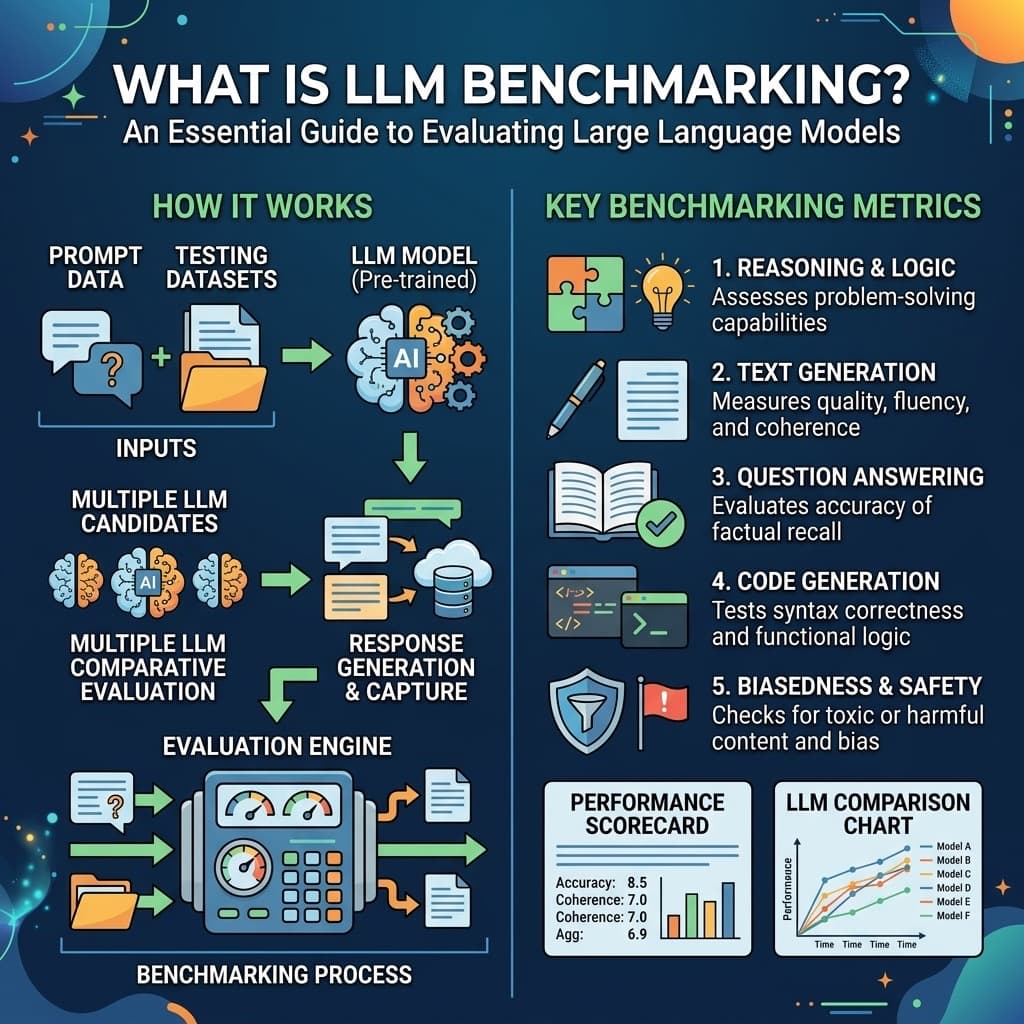
Note on Transparency: This article was generated with the assistance of Artificial Intelligence to provide a comprehensive and up-to-date overview of the discussed topic.
LLM benchmarking is the structured process of testing a large language model against defined tasks, datasets, and metrics to measure its accuracy, safety, and efficiency compared to other models. It's what lets you answer "which model should I use?" with evidence instead of a guess, by tracking whether a model actually improves over time and whether it's safe enough to put in front of users.
Introduction: Navigating the LLM Landscape
The world of Large Language Models (LLMs) has been nothing short of a revolution. It feels like yesterday we were amazed by simple chatbots, and today, models like OpenAI's GPT-4, Google's Gemini, and Meta's Llama 3 are writing code, generating entire articles, and even passing medical exams. Their growth has been exponential, pushing the boundaries of what we thought AI could achieve.
But here's the thing: with great power comes great responsibility – and a critical need for rigorous evaluation. Imagine you're building a house. You wouldn't just trust that the foundations are solid; you'd hire an inspector. The same goes for LLMs. As they become increasingly integrated into everything from customer service to critical decision-making systems, ensuring their reliability, accuracy, safety, and fairness isn't just a good idea; it's absolutely paramount. Without a systematic way to check their performance, we'd be flying blind, unable to tell a groundbreaking model from one that merely sounds good but produces unreliable outputs.
This brings us to the core of our discussion: What is LLM Benchmarking? Simply put, LLM benchmarking is the structured process of putting these powerful AI models through their paces. It's like giving them a comprehensive report card or a detailed fitness test. We evaluate and compare their performance against a defined set of tasks, using specific datasets and objective metrics. Why does it matter so much? Because it provides the empirical evidence we need to:
- Compare models: Which one is truly better for a specific job?
- Inform selection: Helps you pick the right model for your application.
- Track progress: Shows how models improve (or degrade) over time.
- Ensure safety: Identifies biases, toxic outputs, and ethical concerns.
- Optimize efficiency: Helps manage costs and performance in production.
This essential guide will provide you with a comprehensive roadmap. We'll start by demystifying the jargon, dive into the core concepts, explore the tools and datasets available, see LLM benchmarking in action through real-world examples, compare different evaluation strategies, and finally, uncover the common pitfalls to avoid. By the end, you'll be well-equipped to navigate the complex, yet critical, world of LLM evaluation.
Jargon Buster: Demystifying LLM Evaluation Terms
The LLM space is rife with specialized terms, which can feel like a secret handshake. Let's break down the most important ones, so you're not left scratching your head.
-
Large Language Model (LLM): At its heart, an LLM is a sophisticated AI program, often built using transformer architecture, trained on colossal amounts of text data from the internet (books, articles, websites, code – you name it). Their goal is to understand, generate, and process human language, showing remarkable abilities like summarizing, translating, answering questions, and even generating creative content.
Analogy: Think of an LLM as a brilliant student who has read every single book in the world's largest library. They don't just memorize; they've learned the patterns of language so well that they can talk about almost anything, invent new stories, and even help you solve problems.
- Fact: The sheer scale of training data (often trillions of "tokens" or words/sub-words) and parameters (billions, sometimes trillions of adjustable values) is what gives LLMs their foundational power and "emergent properties" – abilities they weren't explicitly trained for but developed from vast exposure to data.
-
Benchmarking: This is our core topic! It's the systematic process of rigorously evaluating and comparing LLMs. We use standardized datasets and specific metrics to objectively measure a model's capabilities, pinpointing its strengths and weaknesses.
Analogy: Benchmarking is like the Olympics for LLMs. Different models compete in various events (tasks), and their performance is measured against objective standards, revealing who the strongest contenders are in specific categories.
- Fact: Effective LLM benchmarking helps drive innovation by highlighting areas where models excel and where further research is needed.
-
Metrics: These are the quantitative "scorecards" we use to assess different aspects of an LLM's performance. They give us numbers to compare.
-
Accuracy, Precision, Recall, F1-score (for classification tasks): These are fundamental for tasks where an LLM categorizes something (e.g., spam or not spam, positive or negative sentiment).
- Accuracy: How many predictions were correct overall? (Correct / Total)
- Precision: Of all the times the model predicted "X," how many were actually "X"? (True Positives / All Predicted Positives)
- Recall: Of all the actual "X"s that exist, how many did the model find? (True Positives / All Actual Positives)
- F1-score: A balanced score, the harmonic mean of precision and recall. Useful when you need a good balance of both.
- Code Snippet Example (Python - scikit-learn):
from sklearn.metrics import accuracy_score, precision_score, recall_score, f1_score

y_true = [0, 1, 0, 1, 0, 1, 0, 1] # Actual labels
y_pred = [0, 1, 1, 0, 0, 1, 0, 1] # Model's predictions

print(f"Accuracy: {accuracy_score(y_true, y_pred):.2f}")
print(f"Precision: {precision_score(y_true, y_pred):.2f}")
print(f"Recall: {recall_score(y_true, y_pred):.2f}")
print(f"F1-Score: {f1_score(y_true, y_pred):.2f}")
Output Explanation: Here,
y_trueare the correct answers, andy_predare what our imaginary LLM predicted. The scores tell us how well it performed in correctly identifying '1's versus '0's.
-
BLEU, ROUGE, METEOR, BERTScore (for text generation): These are specialized metrics for judging how good generated text is by comparing it to one or more human-written "reference" texts.
- BLEU (Bilingual Evaluation Understudy): Focuses on how many n-grams (sequences of N words) in the generated text match the reference. Great for translation tasks, but can miss semantic correctness if wording is different.
- ROUGE (Recall-Oriented Understudy for Gisting Evaluation): Similar to BLEU but emphasizes recall, particularly useful for summarization (how much of the important information from the reference is in the summary?).
- METEOR (Metric for Evaluation of Translation with Explicit ORdering): A more advanced metric that considers synonyms and paraphrases, providing a more robust comparison.
- BERTScore: Leverages powerful contextual embeddings (like BERT's) to calculate similarity. Instead of just word matching, it understands if words or phrases have similar meanings, even if they're not identical. This makes it more semantically aware.
- Code Snippet Example (Python - Hugging Face Evaluate):
# You might need to install 'evaluate', 'sacrebleu', 'rouge_score'
# For BERTScore, 'bert-score' and a transformer model are also needed
import evaluate

references = [["The cat sat on the mat.", "A cat was on the rug.", "On the mat, a cat sat."]] # Multiple possible correct references
predictions = ["The cat was on the mat."] # LLM's generated output

bleu = evaluate.load("bleu")
results_bleu = bleu.compute(predictions=predictions, references=references)
print(f"BLEU score: {results_bleu['bleu']:.4f}")

rouge = evaluate.load("rouge")
results_rouge = rouge.compute(predictions=predictions, references=references)
print(f"ROUGE-L score (Longest Common Subsequence): {results_rouge['rougeL']:.4f}")

# BERTScore (requires 'bert-score' library and a model download)
# bertscore = evaluate.load("bertscore")
# results_bertscore = bertscore.compute(
#     predictions=predictions,
#     references=references,
#     model_type="distilbert-base-uncased" # Smaller model for quicker demo
# )
# print(f"BERTScore F1 score: {results_bertscore['f1'][0]:.4f}")
-
Perplexity: A measure of how "surprised" a language model is by a sequence of words. Lower perplexity means the model is less surprised and thus more confident and accurate in its predictions.
Analogy: Imagine a fortune teller. If they predict the future with low perplexity, their predictions are spot-on and coherent. High perplexity means they're constantly surprised by how things unfold, indicating a poorer understanding.
- Fact: Perplexity is an intrinsic metric often used during an LLM's pre-training to gauge its general language modeling capability.
-
Hallucination Rate: The frequency at which an LLM generates information that sounds plausible but is factually incorrect, nonsensical, or not supported by its training data or the provided context.
Analogy: This is like someone confidently telling you a detailed story that sounds totally convincing but is completely made up.
- Fact: Reducing hallucinations is one of the biggest challenges in making LLMs truly reliable for factual tasks.
-
Toxicity, Bias Scores: Metrics designed to quantify harmful content (e.g., hate speech, discrimination, profanity) or unfair preferences/prejudices an LLM might exhibit.
- Fact: Tools like Google's Perspective API can score text for various toxicity attributes. Ensuring fairness and mitigating bias is a critical part of ethical AI development and LLM benchmarking.
-
-
Datasets: Collections of data used to teach, tune, and test LLMs.
- Evaluation Datasets: Data specifically set aside, never seen during training, to measure a model's performance on unseen examples.
- Test Sets: A subset of the evaluation dataset used for a final, unbiased assessment of a model's performance after all development and tuning are complete.
- Validation Sets: Used during model development (e.g., hyperparameter tuning, fine-tuning) to monitor performance and prevent overfitting.
-
Prompt Engineering: The art and science of crafting the most effective input "prompts" to guide an LLM to generate the desired output. This often involves clear instructions, examples, or specific formatting.
Analogy: Think of prompt engineering as giving clear, step-by-step instructions and perhaps a few examples to a very clever but literal assistant, ensuring they understand exactly what you want done.
- Fact: A well-engineered prompt can drastically improve an LLM's performance without any changes to the model itself.
-
Fine-tuning: Taking a pre-trained, general-purpose LLM and training it further on a smaller, specific dataset to adapt it for a particular task or domain (e.g., medical text generation, legal summarization). This adjusts some of its internal parameters.
Analogy: If the pre-trained LLM is a brilliant general student, fine-tuning is like sending them to a specialized master's program to become an expert in a specific field.
- Fact: Fine-tuning can significantly improve an LLM's performance and relevance for niche applications.
-
Zero-shot, Few-shot, Many-shot Learning: These describe how much example data an LLM gets within the prompt itself at inference time.
- Zero-shot Learning: "Answer this question." (No examples given)
- Few-shot Learning: "Here are 3 examples of what I want. Now, do this one." (A small handful of examples)
- Many-shot Learning (or In-context Learning): Similar to few-shot, but with a larger set of examples, often hundreds, all within the prompt, to teach the model a new task on the fly without retraining.
Analogy: Zero-shot is like asking a chef to cook a dish they've never seen before. Few-shot is showing them 2-3 pictures of the dish. Many-shot is giving them a whole cookbook of similar dishes.
- Fact: These capabilities highlight the incredible "in-context learning" abilities of modern LLMs, allowing them to adapt without explicit retraining.
-
Retrieval Augmented Generation (RAG): An architectural pattern where an LLM is paired with a system that can retrieve relevant information from an external knowledge base (like a database of your company's documents or Wikipedia) before generating a response. This helps ground the LLM's answers in facts and reduces hallucinations.
Analogy: This is like a student who looks up facts in a reliable textbook before answering a question, rather than just guessing or relying solely on their general knowledge.
- Fact: RAG has become a standard technique for building factual and up-to-date LLM applications, especially in enterprises dealing with proprietary data.
-
Alignment: The process of ensuring LLMs behave in a way that is helpful, harmless, and honest, aligning with human values and intentions. This often involves techniques like Reinforcement Learning from Human Feedback (RLHF).
Analogy: Alignment is like patiently training a highly intelligent pet. You teach it commands, reward good behavior, and correct undesirable actions so it acts safely and helpfully within your household.
- Fact: Major LLM developers invest heavily in alignment research and processes to ensure their models are deployed responsibly.
Core Concepts of LLM Benchmarking
Now that we've got our jargon sorted, let's dive into the fundamental principles that underpin effective LLM benchmarking.
Why Benchmark LLMs?
The reasons to engage in LLM benchmarking are multifaceted and critical for anyone working with these models, from researchers to enterprise developers.
- Comparing performance across models and versions: In a rapidly evolving ecosystem, new models and updated versions are released constantly. Benchmarking provides a standardized, objective way to answer questions like: "Is GPT-4 better than Claude 3 Opus for creative writing?" or "Did our latest fine-tuning improve our model's performance on customer queries?" This is essential for competitive analysis and staying at the cutting edge.
- Informing model selection for specific use cases: Not all LLMs are created equal, and one size does not fit all. A model excelling at complex mathematical reasoning might struggle with nuanced creative storytelling. Benchmarking helps you meticulously evaluate models against your specific business needs. For a legal firm, accuracy in extracting clauses is paramount; for a marketing agency, creative fluency takes precedence. LLM benchmarking guides this critical selection process.
- Tracking progress and identifying areas for improvement: By running benchmarks regularly, you establish baselines and monitor how your models evolve over time. This helps researchers pinpoint exactly where a model is strong or weak, directing future research and development efforts. For instance, if an LLM consistently underperforms on factual recall, it signals a need to investigate its training data or retrieval mechanisms.
- Ensuring safety, fairness, and ethical behavior: Beyond raw performance, LLMs pose significant risks related to bias, toxicity, and misinformation. Benchmarking explicitly for these ethical dimensions is crucial. It helps identify if a model generates biased content against certain demographics, spouts harmful language, or produces convincing but false information. This proactive evaluation is a cornerstone of responsible AI development.
- Optimizing for efficiency (cost, latency): Practical deployment of LLMs isn't just about accuracy; it's also about operational efficiency. How fast does the model respond (latency)? How much computational power (and thus cost) does it consume? Benchmarking includes these efficiency metrics, allowing organizations to balance performance with practical deployment constraints and budget.
What Dimensions to Benchmark? (Key Evaluation Areas)
A truly comprehensive LLM benchmarking strategy looks at the model through several distinct lenses:
-
Language Understanding (NLU): This dimension assesses how well an LLM can interpret and comprehend human language.
- What it measures: Reading comprehension, summarization (abstractive and extractive), sentiment analysis, named entity recognition (identifying people, places, organizations), text classification, and question answering based on provided text.
- Why it's important: Crucial for applications like chatbots, document analysis, content moderation, and search. If an LLM can't understand the input, it can't provide a useful output.
- Fact: Benchmarks like GLUE and SuperGLUE were foundational in standardizing NLU evaluation and remain relevant for assessing core understanding.
-
Language Generation (NLG): This dimension focuses on the quality and creativity of the text an LLM produces.
- What it measures: Fluency (grammatically correct, natural-sounding), coherence (logical flow), creativity (novelty, imaginative content), relevance (staying on topic), style adherence (e.g., formal vs. informal tone).
- Why it's important: Essential for tasks like creative writing, dialogue systems, code generation, personalized content creation, and abstractive summarization.
- Fact: Evaluating NLG often requires a significant human component, as automated metrics can struggle with subjective qualities like creativity and nuance.
-
Reasoning & Problem Solving: This area probes an LLM's capacity for higher-level cognitive abilities beyond mere pattern matching.
- What it measures: Mathematical problem-solving, logical inference (drawing conclusions from premises), common-sense reasoning (understanding implicit rules of the world), and scientific reasoning.
- Why it's important: Critical for tasks like scientific discovery, complex question answering, strategic planning, and generating explanations.
- Fact: Benchmarks like GSM8K (math word problems) and ARC (AI2 Reasoning Challenge) are designed to push LLMs on these complex tasks, often revealing significant differences between models.
-
Factuality & Truthfulness: This dimension tackles the critical issue of LLM "hallucinations."
- What it measures: The model's ability to generate accurate information and avoid fabricating facts that are unsupported by its training data or specific input context.
- Why it's important: Absolutely vital for any application where accuracy matters, such as news reporting, legal advice, medical information, or financial analysis. Untruthful outputs can have serious consequences.
- Fact: TruthfulQA is a benchmark specifically crafted to identify LLMs that "confidently lie," highlighting common misconceptions and biases models might pick up.
-
Safety & Ethics: This crucial area ensures LLMs do no harm.
- What it measures: Bias detection (e.g., gender, racial, cultural stereotypes), toxicity (hate speech, profanity, threats), robustness to adversarial prompts (how well it resists attempts to make it generate harmful content), and adherence to privacy guidelines.
- Why it's important: Non-negotiable for public-facing applications. Unethical or unsafe LLMs can spread misinformation, perpetuate discrimination, or be exploited for malicious purposes.
- Fact: Red teaming (where security experts try to break the system) is a key methodology in this dimension, identifying vulnerabilities before deployment.
-
Efficiency: The practical operational aspects of running an LLM.
- What it measures: Inference speed (latency - how long it takes to generate a response), memory usage, computational cost (e.g., GPU hours, energy consumption), and throughput (how many requests it can handle per second).
- Why it's important: Directly impacts user experience (slow chatbots frustrate users) and operational costs. Efficient models are more sustainable and scalable.
- Fact: For real-time applications, inference latency often becomes as critical as accuracy in LLM benchmarking.
How to Benchmark? (Methodologies)
With diverse dimensions, we need a variety of approaches to truly evaluate an LLM.
-
Automated Metrics:
- Description: These rely on algorithms to quantitatively compare an LLM's output against predefined reference answers or objective criteria. Examples include Accuracy, F1-score for classification, and BLEU/ROUGE/BERTScore for text generation.
- Advantages:
- Speed & Scalability: Can evaluate millions of examples in minutes.
- Consistency: Provides objective, reproducible scores every time.
- Cost-effectiveness: Cheaper than human review for large datasets.
- Limitations:
- Lack of nuance: Can struggle with semantic variations in generative tasks (e.g., a perfect answer phrased differently might score poorly).
- Subjectivity: Cannot capture aspects like creativity, tone, or emotional impact.
- Safety/Ethics: Limited ability to detect subtle biases or harmful content on their own.
- Fact: Automated metrics are excellent for tasks with clear "right or wrong" answers, acting like a quick, objective spell-checker for performance.
-
Human Evaluation:
- Description: Involves human annotators (or "raters") assessing the quality, correctness, safety, and other subjective attributes of an LLM's outputs. They provide qualitative feedback and subjective scores.
- Advantages:
- Context & Nuance: Humans understand context, humor, tone, and subjective quality that algorithms miss.
- Judgment: Indispensable for assessing creativity, coherence, empathy, and particularly safety and ethical considerations.
- Ground Truth: Often provides the most reliable "ground truth" for open-ended generative tasks.
- Limitations:
- Cost & Time: Very expensive and time-consuming, especially for large datasets.
- Subjectivity & Inconsistency: Human judgments can vary, leading to inter-annotator disagreement.
- Scalability: Difficult to scale to millions of examples.
- Fact: For complex generative tasks, ethical evaluations, or assessing user experience, human judgment remains the gold standard, acting as the ultimate arbiter of quality.
-
Hybrid Approaches:
- Description: The most practical and effective strategy. It combines the best of both automated and human evaluation. Automated metrics are used for initial large-scale filtering, sampling, or identifying straightforward errors, while human evaluators focus on a smaller, more challenging subset of outputs or subjective quality aspects.
- Fact: Many advanced evaluation pipelines utilize this approach, e.g., using automated metrics to flag potentially toxic content, which is then routed to human reviewers for a definitive judgment.
-
Adversarial Testing & Red Teaming:
- Description: This involves deliberately pushing an LLM to its limits with challenging, unusual, or manipulative prompts. Red teaming specifically involves expert human "adversaries" attempting to elicit undesirable or harmful behaviors (e.g., generating hate speech, leaking private information, assisting in illegal activities).
- Advantages:
- Uncovers vulnerabilities: Highly effective at finding edge cases, safety flaws, and biases that standard benchmarks might miss.
- Increases robustness: Forces developers to build more resilient and safer models.
- Fact: Companies like Google and OpenAI dedicate entire teams to red teaming their LLMs before public release, often involving diverse groups to uncover a wide range of potential harms.
The Landscape of LLM Benchmarking Tools & Datasets
The LLM ecosystem provides a rich array of standardized benchmarks and specialized tools, crucial for effective LLM benchmarking.
Standardized Benchmarks & Leaderboards:
These are the public arenas where LLMs compete, offering common ground for comparison.
-
GLUE/SuperGLUE (Foundational NLU benchmarks):
- Description: The General Language Understanding Evaluation (GLUE) benchmark and its more challenging successor, SuperGLUE, are collections of nine (GLUE) or eight (SuperGLUE) diverse natural language understanding tasks. They range from natural language inference (determining if a sentence logically follows another) to question answering and sentiment analysis.
- Fact: These benchmarks helped propel the field of NLP forward by providing a shared set of tasks to compare models like BERT, RoBERTa, and T5. Models are often evaluated on an average score across all tasks, offering a broad measure of NLU capabilities.
-
MMLU (Massive Multitask Language Understanding):
- Description: A hugely influential benchmark designed to measure an LLM's knowledge across a vast array of subjects, from humanities and social sciences to STEM fields, and at various levels of difficulty (elementary to advanced). It consists of 57 multiple-choice tasks.
- Fact: MMLU is critical for evaluating the breadth and depth of knowledge an LLM has acquired during its pre-training. High scores on MMLU signify a model's impressive general intelligence and ability to handle diverse knowledge domains. Models like GPT-4 and Google's Gemini have shown remarkable performance here.
-
HELM (Holistic Evaluation of Language Models):
- Description: Developed by Stanford CRFM, HELM stands out for its comprehensive and transparent approach. It doesn't just focus on accuracy; it assesses LLMs across a wide array of 16 scenarios (e.g., question answering, summarization, toxicity detection, bias) and 7 core metrics (e.g., accuracy, fairness, robustness, efficiency). It aims to be transparent about the limitations of each evaluation.
- Fact: HELM addresses the "metric myopia" problem by advocating for a more balanced and holistic view of LLM capabilities, emphasizing safety, fairness, and efficiency alongside traditional performance metrics.
-
BIG-bench & BIG-bench Hard:
- Description: The Beyond the Imitation Game benchmark (BIG-bench) is a massive collaborative effort involving hundreds of tasks designed to push the boundaries of LLM capabilities, particularly in areas requiring common sense, reasoning, and multi-step problem-solving. BIG-bench Hard is a curated subset of these tasks, specifically chosen for their difficulty and ability to challenge even the most advanced LLMs.
- Fact: BIG-bench was created to identify "blind spots" in current LLMs and stimulate research into more advanced cognitive abilities beyond rote memorization.
-
TruthfulQA (Evaluating truthfulness):
- Description: A benchmark specifically designed to assess how truthful LLMs are in answering questions, particularly those where humans might be prone to believing misconceptions or false information (e.g., "Is it safe to eat a penny?"). It penalizes answers that are both incorrect and uninformative.
- Fact: TruthfulQA is a crucial tool in the fight against LLM hallucinations, providing a quantitative measure of a model's propensity to generate plausible but false statements.
-
AlpacaEval & MT-Bench (Instruction following):
- Description: These benchmarks focus on evaluating an LLM's ability to follow instructions and generate high-quality, helpful responses in a conversational context. They often employ "LLM-as-a-judge" methodologies, where another powerful LLM (e.g., GPT-4) evaluates the output of the model under test.
- AlpacaEval: Developed by Stanford, it uses a fine-tuned LLM (usually a powerful one) to evaluate other LLMs' instruction-following capabilities across a single turn.
- MT-Bench: Developed by the Vicuna team, it's a multi-turn benchmark (evaluating responses in a conversation with multiple exchanges) and is often judged by GPT-4.
- Fact: LLM-as-a-judge benchmarks offer a scalable alternative to human evaluation for certain tasks, though their own biases and limitations are an active area of research.
-
Open LLM Leaderboard (Hugging Face):
- Description: A widely recognized public leaderboard that tracks and ranks the performance of various open-source LLMs (e.g., Llama, Mistral, Falcon) across several key benchmarks like MMLU, HellaSwag, and ARC. It provides a transparent, community-driven way to compare models.
- Fact: This leaderboard is an invaluable resource for researchers and developers to quickly gauge the state-of-the-art in open-source LLMs and make informed choices for their projects.
Platforms & Frameworks for Evaluation:
Beyond the benchmarks themselves, there are various tools that provide the infrastructure to conduct and manage your LLM evaluations.
-
Open-source tools (e.g., EleutherAI's LM Evaluation Harness, LangChain evaluation modules):
- EleutherAI's LM Evaluation Harness: A powerful and flexible open-source framework for evaluating language models on a vast array of datasets and tasks. It supports many pre-trained models (including Hugging Face models) and makes it easy to reproduce benchmark results.
- Code Snippet Example (Conceptual - running a task with lm-eval):
# Conceptual command for running lm-eval on an MMLU task
# Requires installing lm_eval and a compatible model
# python -m lm_eval --model hf --model_args pretrained=bigscience/bloom-560m --tasks mmlu --batch_size 4
Explanation: This command would instruct
lm_evalto load the Bloom 560M model from Hugging Face and run it against the MMLU benchmark, processing inputs in batches of 4.
- Code Snippet Example (Conceptual - running a task with lm-eval):
- LangChain evaluation modules: LangChain, a popular framework for building LLM applications, includes built-in modules for evaluating the performance of chains, agents, and custom prompts. It supports both traditional metrics and LLM-assisted evaluation.
- Code Snippet Example (Conceptual - LangChain evaluation):
# This is a conceptual example for LangChain's evaluation.
# Actual implementation requires a LangChain chain/agent, a dataset, and evaluators setup.
# from langchain.evaluation import load_evaluator
# from langchain_openai import OpenAI # For a real LLM integration
# from langchain.prompts import PromptTemplate
# from langchain.chains import LLMChain

# # Assuming you have an LLM instance and a chain
# llm = OpenAI(temperature=0)
# prompt = PromptTemplate.from_template("What is the capital of {country}?")
# chain = LLMChain(llm=llm, prompt=prompt)

# evaluator = load_evaluator("qa", llm=llm) # Load a QA evaluator

# inputs = {"country": "France"}
# prediction = chain.run(inputs) # Get prediction from your chain

# # Example of how you might evaluate a prediction against a reference
# # evaluation_result = evaluator.evaluate_strings(
# #     prediction=prediction,
# #     reference="Paris", # The correct answer
# #     input=inputs["country"]
# # )
# # print(evaluation_result)
Explanation: LangChain's evaluation tools help assess if your specific LLM application (your chain) is producing correct and relevant outputs for your designed use case.
- Code Snippet Example (Conceptual - LangChain evaluation):
- EleutherAI's LM Evaluation Harness: A powerful and flexible open-source framework for evaluating language models on a vast array of datasets and tasks. It supports many pre-trained models (including Hugging Face models) and makes it easy to reproduce benchmark results.
-
Cloud provider offerings (e.g., AWS SageMaker, Google Cloud Vertex AI, Azure AI Studio):
- Description: Major cloud platforms integrate robust MLOps capabilities, including services specifically for LLM deployment, monitoring, and evaluation. These often provide interfaces to manage evaluation datasets, run custom evaluation jobs, and track metrics.
- Fact:
- Google Cloud Vertex AI: Offers comprehensive tools for model evaluation, including LLM-specific metrics, custom evaluation setup, and continuous monitoring for drift.
- AWS SageMaker: Provides features for model evaluation, monitoring, and MLOps pipelines, allowing integration with various open-source and custom evaluation libraries.
- Azure AI Studio: Features "prompt flow evaluation" which helps users assess the quality of LLM responses in real-time, iterate on prompt designs, and monitor models.
-
Specialized ML platforms (e.g., Weights & Biases, Arize AI, MLflow):
- Description: These platforms offer advanced MLOps (Machine Learning Operations) capabilities, focusing on experiment tracking, model registry, and robust model monitoring and evaluation, often with dedicated integrations for LLMs.
- Fact:
- Weights & Biases (W&B): Provides excellent tools for logging LLM prompts, generations, and evaluation metrics, making it easy to track experiments, compare different models or prompt versions, and visualize results.
- Arize AI: Specializes in ML observability, offering deep insights into model performance, data drift, bias, and explainability for LLMs in production environments.
- MLflow: Offers a platform for managing the ML lifecycle, including tracking experiments, packaging code, and deploying models, which can be adapted for LLM evaluation workflows to ensure reproducibility and governance.
Creating Custom Benchmarks:
While standardized benchmarks are a great starting point, they can't cover every specific use case. This is where custom benchmarks become invaluable.
- When and how to build tailored evaluation datasets and metrics for specific domains or proprietary tasks:
- When: Custom benchmarks are essential when:
- Your LLM operates in a highly niche domain (e.g., aerospace engineering, specialized medical diagnostics) where public benchmarks lack relevant data.
- You're dealing with proprietary data (e.g., internal company knowledge, sensitive customer information) that cannot be shared publicly.
- Your application has unique performance requirements or success criteria not captured by general metrics (e.g., adherence to a specific brand voice, compliance with a complex internal policy).
- How:
- Define specific use cases and success criteria: Start by clearly articulating what "good" performance looks like for your specific application. What problems are you solving? What constitutes a successful output?
- Curate domain-specific data: Gather high-quality, representative data that mirrors the real-world inputs and expected outputs of your LLM. This often involves manual annotation by subject matter experts or leveraging existing internal datasets, ensuring it's free from data leakage.
- Develop custom metrics: If standard metrics don't capture your unique needs, design new ones. For example, a custom metric for legal summarization might include "number of critical clauses missed" or "compliance with regulatory language."
- Establish reliable ground truth: For each example in your custom dataset, ensure there's a clear, accurate, and consistently annotated "correct" answer or reference against which the LLM's output can be compared. This often requires multiple expert human reviewers.
- Iterate and refine: Benchmarks are not static. As your application evolves and your understanding of the model deepens, continuously refine your datasets, metrics, and evaluation process.
- Fact: Most successful enterprise-level LLM deployments rely heavily on custom, proprietary benchmarks that are closely aligned with their specific business goals and data.
- When: Custom benchmarks are essential when:
Real-World Applications: LLM Benchmarking in Action
LLM benchmarking isn't just an academic exercise; it's a practical necessity driving progress and ensuring reliability across various real-world scenarios.
Enterprise AI Development & Deployment:
-
Model Selection:
- Fact: Before investing significant resources, enterprises rigorously benchmark foundational models (e.g., GPT-4, Claude 3, Llama 3, Google's Gemini) against specific business needs. A company might need an LLM for customer service, content generation, or internal knowledge retrieval. They would benchmark models on key factors like:
- Accuracy: How often does it give correct answers to common customer FAQs?
- Tone & Style: Can it maintain our brand's voice – friendly, formal, concise?
- Latency: Is the response time fast enough for real-time customer interactions?
- Cost: What's the cost per token for inference at our anticipated scale?
- Compliance: Does it meet data privacy (e.g., GDPR, HIPAA) and residency requirements?
- Example: A large e-commerce firm looking to integrate an LLM into its chatbot for product recommendations would benchmark several leading models on their ability to understand complex product queries, accurately suggest items from their catalog, and handle multi-turn conversations gracefully, all while minimizing hallucinations and maintaining a helpful tone.
- Fact: Before investing significant resources, enterprises rigorously benchmark foundational models (e.g., GPT-4, Claude 3, Llama 3, Google's Gemini) against specific business needs. A company might need an LLM for customer service, content generation, or internal knowledge retrieval. They would benchmark models on key factors like:
-
Fine-tuned Model Validation:
- Fact: When an LLM is fine-tuned for a highly specialized task (e.g., generating medical discharge summaries, analyzing complex legal contracts, or writing code in a proprietary language), validation through custom benchmarks is absolutely critical. This ensures the fine-tuning has truly adapted the model to the domain-specific nuances and that it performs reliably on unseen, task-relevant data.
- Example: A healthcare provider fine-tuning an LLM to assist clinicians with summarizing electronic health records would create a custom benchmark with anonymized patient notes. They would evaluate the fine-tuned model on metrics like accuracy of key information extraction (diagnoses, medications, procedures), adherence to medical terminology, and conciseness, comparing its output to summaries created by human physicians.
-
Production Monitoring:
- Fact: LLM benchmarking doesn't end after deployment. LLMs in production can suffer from "model drift" (changes in input data distribution) or performance degradation over time due to new trends, evolving language, or even adversarial attacks. Continuous benchmarking is essential to detect these issues early, ensuring the model maintains its desired performance and safety characteristics.
- Example: A marketing agency using an LLM to generate ad copy might continuously monitor the quality and relevance of the generated text. If a decline in click-through rates (CTR) or an increase in negative customer feedback is observed, automated benchmarks can trigger alerts, prompting human review and potential re-training or prompt adjustments to the LLM.
Academic Research & Open-Source Innovation:
-
Advancing the State-of-the-Art:
- Fact: Academic researchers and open-source contributors rely heavily on standardized benchmarks to validate new LLM architectures, training methodologies, or fine-tuning techniques. Demonstrating superior performance on established benchmarks (like MMLU, HELM, or SuperGLUE) is a common way to prove the efficacy of novel research and publish findings.
- Example: A research team developing a new training technique for making LLMs more efficient might benchmark their new model against existing state-of-the-art models on a suite of NLU and NLG tasks, demonstrating that their efficiency gains don't come at the cost of performance.
-
Driving Community Collaboration:
- Fact: Open leaderboards, such as the Hugging Face Open LLM Leaderboard, are vital for fostering competition, transparency, and collaboration within the broader LLM community. They provide a public, unbiased platform for researchers and developers to compare their models, share insights, and collectively push the boundaries of LLM capabilities.
- Example: When a new open-source model like Mistral or Llama 3 is released, its immediate placement on these leaderboards gives the community a quick, objective assessment of its capabilities, encouraging others to build upon it or develop even better models.
Sector-Specific Use Cases:
-
Healthcare:
- Fact: The high-stakes nature of healthcare demands extremely rigorous LLM benchmarking. Models are evaluated for tasks like clinical note summarization, diagnostic aid accuracy, and patient information generation. Evaluations focus intensely on factual accuracy, adherence to medical guidelines, patient safety, and avoiding harmful or misleading information.
- Example: An LLM designed to assist doctors with differential diagnoses would be benchmarked against a dataset of complex anonymized patient cases, with human medical experts validating the accuracy and safety of its diagnostic suggestions.
-
Finance:
- Fact: In finance, LLMs are used for market trend analysis, fraud detection narrative creation, and financial report summarization. Benchmarking here considers the volatility of financial data, stringent regulatory compliance, and the absolute necessity of precision and auditability.
- Example: An LLM that generates narratives explaining unusual market movements would be benchmarked on its ability to accurately identify and articulate underlying financial drivers, cite relevant data, and adhere to regulatory disclosure language, with financial analysts verifying its factual correctness and compliance.
-
Legal:
- Fact: For legal tasks like contract review, legal research, and compliance document generation, LLM benchmarking focuses on accurate interpretation of complex legal language, consistent application of legal principles, and precise identification of critical clauses.
- Example: An LLM designed to help lawyers review contracts would be benchmarked on its capacity to extract specific contract terms (e.g., termination clauses, force majeure events) with extremely high precision and recall, compared to expert legal annotations.
-
Education:
- Fact: In education, LLMs are being explored for personalized learning paths, content creation, and automated grading. Benchmarks assess pedagogical soundness, accuracy of factual explanations, fairness in assessment, and the ability to adapt to diverse learning styles.
- Example: An LLM generating personalized study guides would be benchmarked for its ability to create factually accurate, engaging, and age-appropriate content tailored to individual student needs, with educators reviewing for pedagogical quality and fairness in content delivery.
Deep Dive into Comparisons: Choosing the Right Evaluation Strategy
Choosing the optimal LLM benchmarking strategy is crucial for obtaining meaningful insights. It's rarely a one-size-fits-all situation; instead, it involves carefully weighing the strengths and weaknesses of different approaches.
Automated Metrics vs. Human Evaluation:
Here’s a comparison to help guide your choice:
| Feature | Automated Metrics | Human Evaluation |
|---|---|---|
| Speed | Very Fast | Slow |
| Scalability | High (can evaluate millions of examples) | Low (limited by human capacity) |
| Consistency | High (objective, reproducible scores) | Moderate to Low (subjective, prone to disagreement) |
| Cost | Low (once implemented) | High (labor-intensive) |
| Best For | Well-defined tasks, factual accuracy, objective comparison | Nuance, creativity, subjective quality, safety, ethics |
| Limitations | Lacks nuance, struggles with semantics, limited for ethics | Costly, slow, subjective bias, difficult to scale |
| Example Tasks | Question Answering, Text Classification, Factual Summarization | Creative Writing, Dialogue Coherence, Toxicity/Bias Detection |
-
When to Prioritize Automated:
- Automated metrics are your go-to for speed, scale, and consistency in well-defined tasks where objective ground truth is clear. Think of scenarios like:
- Question Answering: Is the answer "Paris" or not?
- Factual Extraction: Did the LLM correctly pull out all dates from a document?
- Classification: Is the sentiment positive or negative?
- They are highly cost-effective for initial screening, large-scale dataset analysis, or for quickly tracking performance regressions after model updates.
- Fact: For many core NLU tasks, automated metrics are the backbone of efficient LLM development, allowing rapid iteration and comparison across models.
- Automated metrics are your go-to for speed, scale, and consistency in well-defined tasks where objective ground truth is clear. Think of scenarios like:
-
When Human Judgment is Indispensable:
- Human evaluation becomes non-negotiable when dealing with nuance, creativity, subjective quality, safety, and ethical considerations.
- Creative Writing: Is the poem engaging, original, and emotionally resonant?
- Complex Dialogue: Does the chatbot's response feel natural, empathetic, and coherent across multiple turns?
- Avoiding Harmful Outputs: Does the model generate subtle biases, implicit stereotypes, or manipulative content that automated tools might miss?
- Fact: OpenAI's groundbreaking work with Reinforcement Learning from Human Feedback (RLHF) for models like ChatGPT demonstrates the critical role of human judgment in aligning LLMs with human values.
-
Strategies for Hybrid Approaches:
- The most effective LLM benchmarking strategies often combine both. This involves using automated metrics for initial, large-scale assessment to filter, sample, or identify clear errors. Then, a smaller, targeted human review focuses on a subset of the outputs, especially those that are ambiguous, challenging, or require subjective assessment.
- Example: An LLM generating code snippets might first be evaluated by automated unit tests for functional correctness. Code snippets that pass (or fail in interesting ways) could then be sent to human developers to assess code quality, readability, efficiency, and adherence to best practices.
- Fact: Many specialized ML platforms and cloud providers now offer integrated workflows that facilitate this hybrid approach, allowing for efficient data labeling and quality assurance.
Open-Source/Standardized Benchmarks vs. Proprietary/Custom Benchmarks:
-
Benefits & Limitations of Universal Benchmarks (e.g., MMLU, HELM):
- Benefits:
- Broad Comparisons: Allow direct comparisons of models from different institutions and research groups.
- Community Consensus: Foster shared understanding and accelerate progress in the field.
- Publicly Available: Often well-documented, maintained, and accessible to everyone.
- Limitations:
- Lack of Domain Specificity: May not reflect the unique data distributions or performance requirements of niche, proprietary, or highly specialized applications.
- Gaming the System: Models can sometimes be "over-optimized" for public benchmarks, potentially leading to impressive scores that don't always translate to real-world utility or robustness in diverse, unconstrained environments.
- Fact: While universal benchmarks are crucial for scientific progress and public accountability, relying solely on them for enterprise applications can be misleading.
- Benefits:
-
The Necessity of Custom Benchmarks:
- When off-the-shelf solutions don't reflect your unique use case, data, or performance requirements: Custom benchmarks are indispensable for organizations deploying LLMs in specific business contexts. They ensure that the model is truly being evaluated on the data and tasks it will encounter in production, against metrics that directly align with business value.
- Methodology for building robust custom evaluations: (As discussed in Section 4) This involves a meticulous process of defining precise success criteria, curating high-quality domain-specific datasets (often annotated by in-house experts), and developing tailored metrics that capture the nuances of the task.
- Fact: Companies like Google and Microsoft develop extensive internal, proprietary benchmarks to evaluate their models on internal use cases and sensitive datasets before public release or internal deployment.
-
Considerations for Data Privacy & Security:
- Protecting sensitive information when creating and using proprietary evaluation datasets: When creating custom benchmarks, especially with sensitive data (e.g., personal health information, financial records, confidential business documents), stringent data privacy and security measures are paramount. This includes:
- Anonymization/Pseudonymization: Removing or masking personally identifiable information.
- Access Control: Limiting who can access and work with the data.
- Secure Storage & Transmission: Encrypting data at rest and in transit.
- Compliance: Adhering to relevant regulations (GDPR, HIPAA, CCPA).
- Fact: Data governance and security are critical considerations that must be integrated into the design of any custom LLM benchmarking pipeline involving sensitive information.
- Protecting sensitive information when creating and using proprietary evaluation datasets: When creating custom benchmarks, especially with sensitive data (e.g., personal health information, financial records, confidential business documents), stringent data privacy and security measures are paramount. This includes:
Pre-trained Model Benchmarking vs. Fine-tuned Model Benchmarking:
-
Evaluating Foundational Capabilities:
- Assessing a large model's general knowledge, reasoning, and language understanding out-of-the-box: This typically involves running a foundational model (like a base Llama 2 or an un-fine-tuned GPT-3) on general-purpose benchmarks such as MMLU, HELM, or BIG-bench. The goal is to understand its inherent "intelligence," broad knowledge, and general language abilities before any task-specific modifications.
- Fact: This initial evaluation helps determine which foundational model provides the best starting point for your application, weighing its general capabilities against cost and computational requirements.
-
Assessing Task-Specific Performance:
- Measuring how well a model performs after adaptation (fine-tuning, prompt engineering, RAG) for a particular application: Once a model has been adapted—either through fine-tuning, sophisticated prompt engineering, or augmentation with RAG—evaluation shifts to highly specific, often custom, benchmarks that directly measure its performance on the target application.
- Fact: Fine-tuning can significantly alter a model's behavior, making task-specific evaluation indispensable. For instance, a model fine-tuned for legal document summarization would be evaluated on its ROUGE scores for legal summaries or by human legal experts for factual accuracy and adherence to legal nuance on relevant documents.
-
The Impact of Prompt Engineering and RAG on Evaluation:
- How these techniques can drastically alter model behavior and require tailored evaluation strategies:
- Prompt Engineering: The prompt is the primary interface for instructing LLMs. Evaluating a prompt-engineered LLM means evaluating the effectiveness of the prompt itself. This involves A/B testing different prompt structures, assessing clarity of instructions, and measuring how well the model adheres to constraints defined within the prompt.
- Retrieval Augmented Generation (RAG): When an LLM is paired with a retrieval system, the evaluation must consider both components. Metrics will assess not only the LLM's generation quality but also the retrieval system's accuracy and relevance in fetching the correct documents. Common metrics include retrieval precision/recall and a new metric called "groundedness" (the extent to which the LLM's answer is supported only by the retrieved documents).
- Fact: Evaluating RAG systems often requires a specific type of human judgment to assess whether the retrieved documents were indeed relevant and if the generated answer is both correct and fully supported by those documents. This ensures the LLM isn't hallucinating even when provided with a knowledge base.
- How these techniques can drastically alter model behavior and require tailored evaluation strategies:
Common Pitfalls and Challenges in LLM Benchmarking
Despite its critical importance, LLM benchmarking is not without its traps. Navigating these challenges is essential to avoid drawing misleading conclusions and to build truly robust and reliable AI systems.
-
Data Leakage and Contamination:
- The risk of evaluation data being present in training sets, leading to artificially inflated scores: This is perhaps the most insidious pitfall. If an LLM has, by chance, seen or learned from the exact data used in its evaluation benchmarks during its massive pre-training phase, its performance on those benchmarks will appear artificially high. It's like giving a student the exam questions before the test; they'll ace it, but it doesn't reflect their true understanding or generalization ability.
- Fact: With the sheer scale of LLM pre-training datasets (trillions of tokens), it's incredibly difficult to guarantee zero overlap with any public benchmark. Researchers constantly work to create novel, "unseen" test sets to mitigate this risk, but it remains a persistent challenge.
-
Metric Myopia:
- Over-reliance on a single metric, failing to capture the full spectrum of an LLM's capabilities or limitations: Obsessing over one metric, like accuracy, can create a false sense of security. A model might achieve high accuracy but be incredibly biased, generate toxic content, or lack robustness to minor adversarial inputs. This narrow focus can blind us to critical flaws.
- Fact: The development of holistic frameworks like HELM directly addresses metric myopia by pushing for a broader, multi-dimensional assessment, forcing evaluators to consider safety, fairness, and efficiency alongside traditional performance scores.
-
Human Evaluation Bias & Inconsistency:
- Subjectivity, high cost, and scalability issues of human reviewers: While indispensable for nuance, human judgments are inherently subjective. Different annotators may interpret instructions differently, leading to inconsistent ratings. The process is also notoriously expensive and slow, making it difficult to scale for the continuous evaluation of large datasets.
- Fact: Strategies like clear annotation guidelines, extensive rater training, and calculating inter-annotator agreement (how much human raters agree with each other) are employed to mitigate human bias and improve consistency.
-
Dynamic Nature of LLMs:
- The rapid evolution of models can quickly render benchmarks outdated: The LLM field is moving at lightning speed. Benchmarks designed last year might not adequately challenge or differentiate the capabilities of today's state-of-the-art models. Models quickly "max out" easier benchmarks, requiring constant innovation in evaluation design.
- Fact: The need for ever-harder benchmarks (e.g., BIG-bench Hard) is a direct consequence of this rapid evolution, pushing researchers to create more complex tasks that continue to stress-test advanced LLMs.
-
Computational Cost & Resource Intensity:
- Running extensive evaluations can be expensive and time-consuming: Evaluating large models on numerous benchmarks, especially with human evaluation components, requires significant computational resources (often expensive GPUs) and considerable time. This can be prohibitive for smaller research groups, startups, or even large companies with limited budgets.
- Fact: Efficiency considerations are becoming an integral part of LLM benchmarking, with frameworks like HELM explicitly including efficiency metrics in their holistic evaluations.
-
Lack of Ground Truth for Generative Tasks:
- Difficulty in defining a "perfect" or "correct" output for open-ended generation: For tasks like creative writing, open-ended dialogue, or abstractive summarization, there isn't a single, universally "correct" answer. Multiple outputs can be equally valid and high-quality. This makes automated comparison to a fixed "ground truth" challenging and often necessitates subjective human judgment.
- Fact: Automated metrics like ROUGE and BLEU attempt to approximate quality by comparing to reference texts, but they often struggle to reward diverse or truly novel generations.
-
Gaming the System:
- Models optimizing for benchmark scores rather than true real-world utility or robustness: If benchmarks become too predictable or narrow, developers might inadvertently optimize models to perform well on those specific tests rather than genuinely improving their underlying capabilities, general intelligence, or real-world applicability. This can lead to models that look impressive on leaderboards but fail in diverse, unconstrained environments.
- Fact: This phenomenon, often dubbed "Goodhart's Law" ("When a measure becomes a target, it ceases to be a good measure"), is a known risk in AI development. Designing diverse, ever-evolving benchmarks helps combat this.
-
Overlooking Ethical Considerations:
- Failing to explicitly evaluate for fairness, bias, privacy, and safety: If LLM benchmarking focuses solely on raw performance metrics (like accuracy or F1-score) and neglects ethical dimensions, there's a significant risk of deploying models that perpetuate or amplify societal biases, generate harmful content, or compromise user privacy.
- Fact: Responsible AI development necessitates integrating ethical considerations into the core of the evaluation strategy, not as an afterthought. This requires dedicated benchmarks, red teaming, and human-in-the-loop processes.
FAQ
What is LLM benchmarking in simple terms?
LLM benchmarking is running a language model against a standardized set of tasks and datasets, then scoring it on metrics like accuracy, safety, and efficiency, so you can compare it objectively against other models instead of relying on impressions.
What are the most common LLM benchmarks?
Widely used benchmarks include MMLU (broad subject-matter knowledge), HELM (a holistic view across accuracy, fairness, robustness, and efficiency), TruthfulQA (resistance to plausible-sounding misinformation), BIG-bench Hard (multi-step reasoning), and instruction-following benchmarks like MT-Bench and AlpacaEval.
What does "LLM-as-a-judge" mean?
It's an evaluation method where a strong LLM (commonly GPT-4-class models) scores the output of the model being tested, instead of a human rater. It scales far better than manual human evaluation, though the judge model's own biases can skew results.
Why do LLM benchmark scores sometimes not reflect real-world performance?
This is often called "benchmark gaming" or Goodhart's Law: when a score becomes the target, teams may over-optimize a model for that specific test rather than for general capability. That's why holistic frameworks like HELM deliberately evaluate multiple dimensions instead of one leaderboard number.
How is benchmarking different from red teaming?
Benchmarking measures performance against fixed tasks and metrics. Red teaming is adversarial: people (or other models) deliberately try to make the LLM fail, produce harmful output, or reveal safety gaps. Responsible deployment typically uses both.
Do I need to run my own benchmarks, or can I rely on public leaderboards?
Public leaderboards (like the Hugging Face Open LLM Leaderboard) are a good starting point for comparing general capability, but they rarely reflect your specific use case. For production decisions, you should also evaluate the model against your own representative tasks and data.
Conclusion: Mastering the Art of LLM Evaluation
Our journey through the dynamic landscape of Large Language Models has revealed a fundamental truth: effective and ethical evaluation is not merely an optional step, but an indispensable pillar of responsible LLM development and deployment. As these powerful AI systems continue their exponential growth and integrate deeper into every facet of our lives, mastering the art of LLM benchmarking becomes paramount for ensuring they are consistently helpful, harmless, and honest.
Key Takeaways for Effective and Ethical LLM Evaluation:
- Embrace a Holistic Approach: Move beyond single, isolated metrics. A truly insightful evaluation considers a broad spectrum of dimensions: language understanding, generation, reasoning, factuality, safety, ethics, and efficiency. Frameworks like HELM champion this comprehensive view.
- Leverage Hybrid Methodologies: Combine the speed and scalability of automated metrics with the irreplaceable nuance and contextual judgment of human evaluation. This strategic blend offers the most robust and practical approach, especially for subjective and high-stakes tasks.
- Context is King: The "best" evaluation strategy is always context-dependent. While standardized benchmarks provide valuable baselines for general capabilities, custom benchmarks—tailored to your specific use case, data, and business objectives—are essential for real-world application success.
- Practice Continuous Evaluation: LLM benchmarking is not a one-time event. Implement continuous monitoring and evaluation of your models in production to proactively detect performance degradation, model drift, and emerging biases over time, ensuring sustained reliability.
- Prioritize Safety and Ethics: Integrate robust ethical considerations, bias detection, and adversarial testing (red teaming) into every stage of your evaluation process. This proactive approach is critical for mitigating risks and building AI systems that are fair, transparent, and trustworthy.
- Strive for Transparency and Reproducibility: Document your evaluation methodologies, clearly report results, and ensure your experiments are reproducible. This fosters trust, enables collaborative progress within the AI community, and contributes to responsible scientific practice.
The continuous evolution of LLM benchmarking practices is a direct reflection of the rapid advancements in the field itself. As models become more capable, multimodal (handling text, images, audio), and deeply integrated into complex autonomous systems, our evaluation techniques must adapt at an equal pace. The future of LLM evaluation will undoubtedly move towards:
- More Sophisticated LLM-as-a-Judge Paradigms: Further refining the use of powerful LLMs to evaluate other LLMs, addressing concerns about evaluator bias and enhancing scalability.
- Real-World Task-Based Evaluations: Shifting beyond static datasets to evaluate models directly within interactive and dynamic environments that more closely mirror their real-world deployment, emphasizing utility over isolated metrics.
- Emphasis on Interpretability and Explainability: Developing benchmarks that not only tell us what a model does but also why it makes certain decisions, fostering greater trust, accountability, and debugging capabilities.
- Universal Safety and Ethical Benchmarks: Establishing globally accepted and standardized benchmarks for critical aspects like bias mitigation, toxicity detection, and robustness against adversarial attacks, ensuring a consistent bar for responsible AI.
By diligently embracing these principles and proactively adapting to the evolving landscape, we can ensure that Large Language Models are developed, deployed, and managed responsibly, unlocking their immense potential to benefit humanity while diligently safeguarding against their inherent risks. Mastering the art of LLM benchmarking is, in essence, mastering the art of building better, safer, and more beneficial artificial intelligence for the future.
The Weights Are Already There: A 3 AM Theory on Human Potential and AI
Backpropagation for the Soul: Reprogramming Your Mind Like You'd Retrain a Model
Guardrails vs. Input Sanitization: The Ultimate Defense Strategy for LLMs
Introduction to Large Reasoning Models
Prompt Injection Explained: Understanding AI's Most Common Vulnerability
5 Game-Changing Vector Database Use Cases You Need to Know
What is a Vector Database? Your Essential Guide to AI's New Memory
Unlocking the Power of Retrieval-Augmented Generation
From Prompts to Context: Mastering Context Engineering for Autonomous AI Agents in 2026
Introduction to Embedding and Embedding Models in AI
Unlocking the Power of Large Multimodal Models in AI
Digital Immortality: Life Beyond the Physical
Understanding Model Context Protocol (MCP)
Mastering Markdown Prompting ✨