Note on Transparency: This article was generated with the assistance of Artificial Intelligence to provide a comprehensive and up-to-date overview of the discussed topic.
Positivity as a Training Signal: What Machine Learning Taught Me About Mindset
1. The Architecture of Reinforcement: How Loss Functions Shape Behavior
Translating Gradient Descent from Neural Networks to Human Neuroplasticity
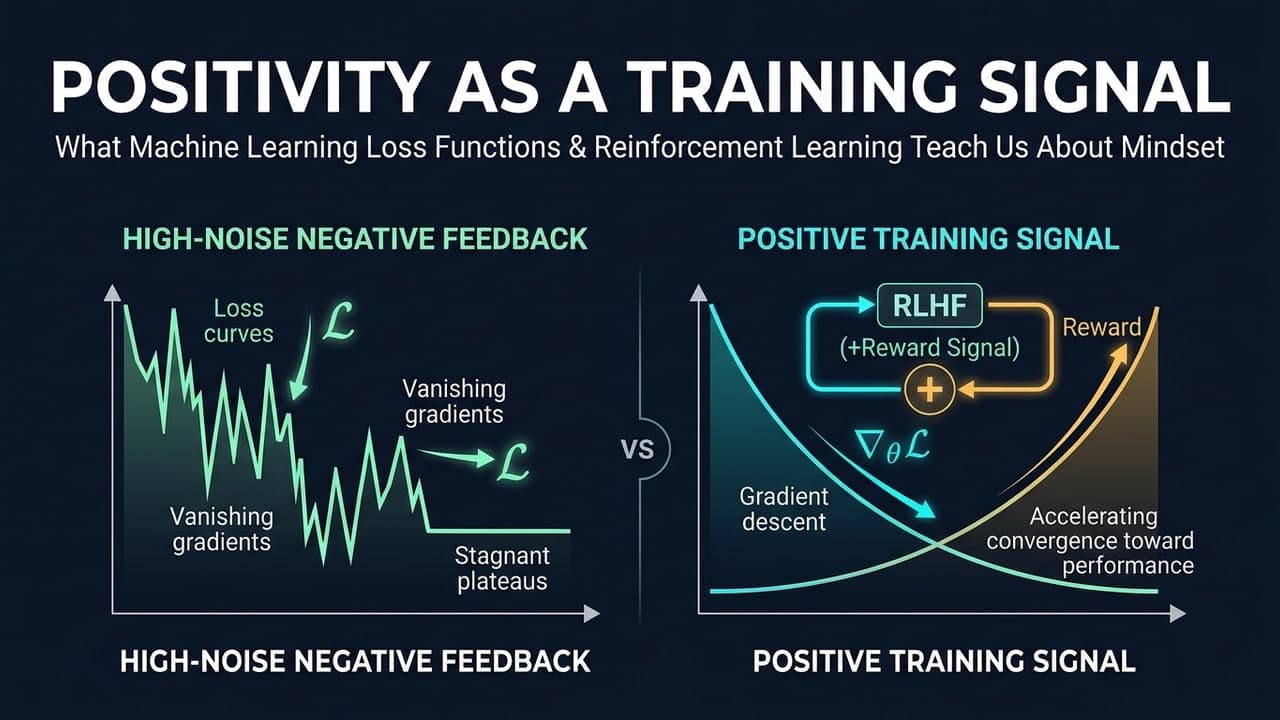
In machine learning, an optimization algorithm does not know what "good" is inherently; it only knows how to measure how "wrong" it is through a loss function (L), a mathematical formula that calculates the penalty for incorrect predictions. During training, the model computes the gradient of the loss with respect to its weights (∇_θ L)—representing the direction of steepest error—and takes small steps in the opposite direction to minimize mistakes:
θ(t+1) = θ(t) - η · ∇_θ L(y, f(x; θ))
Human neuroplasticity—the brain’s ability to reorganize itself by forming new neural connections—operates on an analogous computational loop. The brain continuously predicts sensory and emotional outcomes through predictive coding and evaluates prediction errors. However, unlike a static neural network where the loss function is mathematically rigid, the human mind's internal reward and penalty functions are dynamically shaped by cognitive framing.
When we treat life as a continuous error-correction loop, constantly scanning for what is broken, we set our internal gradient descent to optimize for avoidance rather than discovery. Translating this mechanism means recognizing that human action is driven by synaptic weight adjustments reinforced by dopamine pathways. Dopamine does not merely encode pleasure; it encodes reward prediction error (RPE), which is the mathematical discrepancy between what we expect to happen and what actually occurs:
RPE = Actual Reward - Expected Reward
By deliberately designing thoughts and environments that trigger positive RPEs, such as surprising ourselves with small wins and celebrating micro-progress, we strengthen specific neural pathways through long-term potentiation, physically altering the structural architecture of the brain.
Why Punishing Mistakes (Negative Reinforcement) Creates Local Minima in Personal Growth
In mathematical optimization, a local minimum is a point in the search space that is optimal within its immediate neighborhood, but significantly worse than the global minimum, which represents the absolute best possible outcome.
Loss
  |      \      /\      (Global Minimum)
  |       \    /  \        *
  |  (Local) \  /    \      /
  |    *      \/      \    /
  +----------------------------------> Weights / Parameter Space
When individuals or organizations rely heavily on negative reinforcement, such as punishment, shame, and hyper-critical self-flagellation, to drive behavior, they engineer a loss landscape fraught with sharp, jagged local minima.
- The Mathematics of Fear: Fear-based conditioning forces the parameter space to over-index on safety. The model learns a policy that minimizes severe penalties rather than maximizing capability.
- Exploration vs. Exploitation Trade-off: In Reinforcement Learning, exploration is controlled by strategies that balance trying new behaviors versus exploiting known rewards. Fear drastically shrinks this exploration coefficient. The mind stops exploring novel solutions because the psychological penalty of a failed experiment is coded as catastrophic. Consequently, the individual gets trapped in a suboptimal local minimum—functioning adequately to survive, but structurally incapable of reaching higher-order states of performance or creativity.
Designing Your Internal Reward Function: Defining What "Success" Looks Like to Subconscious Processing
To escape local minima, machine learning engineers use advanced reward shaping, sparse-to-dense reward transformations, and intrinsic motivation modules. Similarly, rewriting human behavior requires engineering a precise internal reward function.
The subconscious mind does not process abstract negations well, such as "Don't mess up" or "Stop procrastinating." It requires explicit, positive target states. To design an internal reward function:
- Define the Dense Reward Signal: Instead of waiting for a sparse, delayed ultimate reward like publishing a book or getting a promotion, break goals into high-frequency intermediate states that trigger dopamine release.
- Shift from Binary to Continuous Optimization: Replace pass/fail mindsets with continuous metrics of progress. Reward iteration speed rather than perfection of initial output.
- Explicit Reward Function Example:
By shifting focus to rewarding curiosity, the subconscious is incentivized to explore novel behavioral spaces.Internal Reward (R) = w₁(Task Completion) + w₂(Curiosity Exhibited) - w₃(Stagnation Time)
2. Rewriting the Weights: The Mechanics of Positive Adaptation
How Reinforcement Learning Prioritizes High-Reward Pathways Over Error Correction
Modern reinforcement learning algorithms demonstrate that models trained via positive reinforcement, by maximizing cumulative discounted reward over time, build more robust, generalized policies than those trained solely on corrective feedback.
When an agent receives a positive reward, its policy network updates its probability distribution to make that successful action sequence more likely in similar future states. Mathematically, policy gradients scale the parameter update directly by the magnitude of the reward:
∇_θ J(θ) = E_π_θ[ ∇_θ log π_θ(a|s) · Q^π(s,a) ]
If the action-value function Q^π(s,a) is high and positive, the gradient pushes the parameters strongly in that direction.
Human Implication: When you focus intensely on what you did right and amplify it, you reinforce the neural pathways responsible for that success. Conversely, obsessing over errors triggers high-variance, unstable gradients. As behavioral psychology shows, focusing exclusively on what not to do leaves the actor paralyzed, lacking a clear policy for what to do instead.
Shifting Focus from Debugging Failures to Amplifying Iterative Wins
In software development, debugging is necessary, but a codebase built only by patching bugs without architectural refactoring becomes unmaintainable spaghetti code. The same applies to human psychology.
- The Error-Debugging Loop: Analyzing failures endlessly creates cognitive rumination, activating the brain's Default Mode Network in ways associated with anxiety and depression.
- The Iterative Win Loop: Amplifying wins leverages appreciative inquiry and positive reinforcement cycles. By identifying moments where performance was optimal and reverse-engineering the exact psychological and environmental conditions that produced them, you create a repeatable template.
# Conceptual Python Representation: Error-Driven vs. Reward-Driven Adaptation

def error_driven_mindset(current_state, error):
    # Fixes the immediate bug, but leaves the underlying architecture fragile
    weights = weights - learning_rate * compute_gradient(error)
    return weights

def positive_adaptation_mindset(current_state, high_reward_action):
    # Reinforces and generalizes successful pathways
    advantage = compute_advantage(high_reward_action)
    weights = weights + learning_rate * advantage * compute_policy_gradient(high_reward_action)
    return weights
Building Momentum Through High-Frequency, Low-Friction Positive Feedback Loops
Momentum in machine learning training is captured explicitly via the Momentum optimizer, which adds a fraction of the previous update vector to the current update to accelerate progress along valleys and dampen oscillations.
In human behavior, momentum is engineered by shrinking the timestep of feedback loops.
- Low-Friction Loops: Reduce the activation energy required to achieve a micro-win.
- High-Frequency Loops: Instead of waiting for a quarterly review or a yearly milestone, implement daily closure rituals where accomplishments—no matter how minor—are explicitly acknowledged. This builds a psychological momentum vector, carrying the individual smoothly past points of friction and resistance.
3. In Production: Modern Applications of Positive Reinforcement Systems
High-Performance Engineering: Psychological Safety and Positive Velocity Tracking
Elite engineering organizations have proven that fear-driven cultures underperform compared to systems grounded in psychological safety and positive reinforcement.
- Psychological Safety as Regularization: In machine learning, regularization techniques prevent overfitting by adding controlled noise or penalties to prevent models from memorizing exact training samples. In engineering teams, psychological safety acts as a positive regularizer—it prevents team members from overfitting to rigid, fear-based compliance, allowing them to generalize, take calculated risks, and innovate.
- Positive Velocity Tracking: Instead of tracking vanity metrics like lines of code or weaponizing post-mortems to find culprits, high-performing teams track flow state metrics, deployment frequency, and lead time for changes, celebrating successful deployments and treating failures as system bugs rather than human flaws.
Algorithmic Habit Formation: Replicating RLHF in Daily Routine Design
Reinforcement Learning from Human Feedback (RLHF)—the breakthrough technique used to align large language models like GPT-4 or Claude—relies on training a reward model based on human preferences, followed by policy optimization.
[ LLM Generations ] ---> [ Human Rater Preference ] ---> [ Reward Model ] ---> [ PPO Policy Optimization ]
We can replicate RLHF principles in daily behavioral design:
- The Generator: Your daily actions and spontaneous routines.
- The Reward Model (Internal Critic): Consciously training your self-talk to act as a supportive reward model rather than a punitive critic. When you complete a positive habit, immediately pair it with a mental or physical reward like celebration, high-value rest, or verbal self-affirmation.
- Policy Alignment: Over time, your subconscious policy aligns with the rewarded behaviors, making high-friction habits like deep work, exercise, or continuous learning default, low-resistance pathways.
Adaptive Leadership: Moving Away from Fault-Finding Code Reviews Toward Systemic Amplification
Traditional management mirrors bad code review practices: scanning pull requests exclusively for syntax errors, typos, and stylistic violations, often leaving engineers feeling defensive and demoralized.
Adaptive Leadership (Systems-Level Positive Reinforcement):
- Blameless Post-Mortems: When an outage occurs, elite teams assume the human acted rationally given the information and tools available. They debug the system architecture, not the person.
- Amplifying What Works: Leaders practicing positive adaptation run positive deviance studies—identifying teams or individuals who consistently outperform expectations under identical constraints, analyzing their workflows, and scaling those practices across the organization.
4. Debugging the Mind: Loss Functions Compared
Error-Driven Training vs. Reward-Driven Optimization: A Side-by-Side Analysis
| Dimension | Error-Driven Training (Fear/Punishment) | Reward-Driven Optimization (Aspiration/Positivity) |
|---|---|---|
| Primary Driver | Avoidance of negative consequence, shame, or penalty. | Pursuit of growth, mastery, and positive reinforcement. |
| Neural Correlate | Hyper-activation of the amygdala; cortisol and stress hormone release. | Dopaminergic activation of the mesolimbic pathway; anticipation of reward. |
| Optimization Landscape | Jagged, high-penalty walls; traps the system in safe local minima. | Smooth, expansive gradient spaces; encourages global exploration. |
| Adaptability | Rigid; breaks down under novel, high-stress conditions. | Resilient; high generalization capability and creativity. |
| Long-Term Output | Burnout, risk aversion, systemic stagnation, and model degradation. | Sustainable high performance, intrinsic motivation, and continuous evolution. |
The Long-Term Degradation of Models (and Minds) Trained Exclusively on Avoidance of Penalty
In machine learning, a model trained exclusively on avoiding negative edge cases suffers from catastrophic forgetting and covariate shift—it becomes brittle when exposed to inputs outside its narrow safe zone.
Human minds trained exclusively on the avoidance of failure experience a parallel degradation:
- Learned Helplessness: Chronic negative reinforcement extinguishes proactive behavior. If every action risks punishment or criticism, the optimal strategy learned by the organism is inaction.
- Cognitive Narrowing: Fear physically constricts attentional focus to immediate threat detection, starving the prefrontal cortex of resources needed for long-term strategic planning, empathy, and abstract reasoning. Over time, the mind's dynamic range flattens, resulting in chronic fatigue, burnout, and diminished psychological resilience.
5. Converging on a Global Minimum: The Ultimate Convergence of Code and Mindset
When we synthesize the rigorous principles of machine learning with the science of human neuroplasticity, a profound truth emerges: What you reinforce, you optimize.
Whether updating weights in a multi-billion parameter transformer model or restructuring the neural pathways of human consciousness, the mechanics of adaptation remain universal. Punishment and error-fixation act as brittle heuristics, trapping systems in local minima of survival and stagnation. True transformation—scalable, resilient, and continuously evolving—requires shifting the core objective function.
By designing internal reward structures that celebrate iterative progress, fostering psychological safety, and treating setbacks as system telemetry rather than moral failures, we transition from reactive debugging to proactive optimization. In both code and mindset, the path to the global minimum is paved not by punishing every wrong turn, but by relentlessly illuminating, rewarding, and amplifying the right ones.
The Weights Are Already There: A 3 AM Theory on Human Potential and AI
Your Brain Is a Neural Network: Why the Input You Feed It Decides the Output
Backpropagation for the Soul: Reprogramming Your Mind Like You'd Retrain a Model
Introduction to Large Reasoning Models
What is LLM Benchmarking? An Essential Guide to Evaluating Large Language Models
5 Game-Changing Vector Database Use Cases You Need to Know
Introduction to Embedding and Embedding Models in AI
Legacy Systems Modern Minds