Note on Transparency: This article was generated with the assistance of Artificial Intelligence to provide a comprehensive and up-to-date overview of the discussed topic.
We Are All Pre-Trained Models: Fate, Free Will, and the Illusion of Limits
Table of Contents
-
The Architecture of Inheritance: Biology, Culture, and the Great Initialization
- How our genetic code, linguistic structures, and historical contexts serve as humanity's foundational training data.
- Moving past the blank slate: Why we arrive in the world already heavily parameterized.
-
Fine-Tuning Our Weights: The Mechanics of Choice, Experience, and Adaptation
- The daily update cycle: How environmental feedback, trauma, and education subtly adjust our internal behavioral weights.
- The illusion of tabula rasa agency versus the reality of constrained optimization.
-
In the Wild: Living and Prompting Inside Complex Societal Environments
- The Autocomplete Life: How modern predictive algorithms and cultural echo chambers steer human decision-making in real time.
- Context Windows and Attention Spans: Why our immediate environments dictate which parts of our internal "model" we actually activate.
- Hallucination and Creativity: The biological and cognitive parallels of generating novel outputs from finite training distributions.
-
Decoding the Latent Space: Determinism, Autoregressive Futures, and Emergence
- A comparative look at hard determinism, compatibilism, and stochastic freedom through the lens of machine learning states.
- Mapping out the "latent space" of human potential: Are we doomed to follow the path of least resistance, or can we steer the trajectory?
-
Rewriting the Loss Function: Finding Meaning in a Pre-Trained Existence
- Redefining autonomy, responsibility, and personal growth when absolute, unconditioned free will is proven to be a mathematical fiction.
- Embracing our parameters to build more conscious, deliberate futures.
The Architecture of Inheritance: Biology, Culture, and the Great Initialization
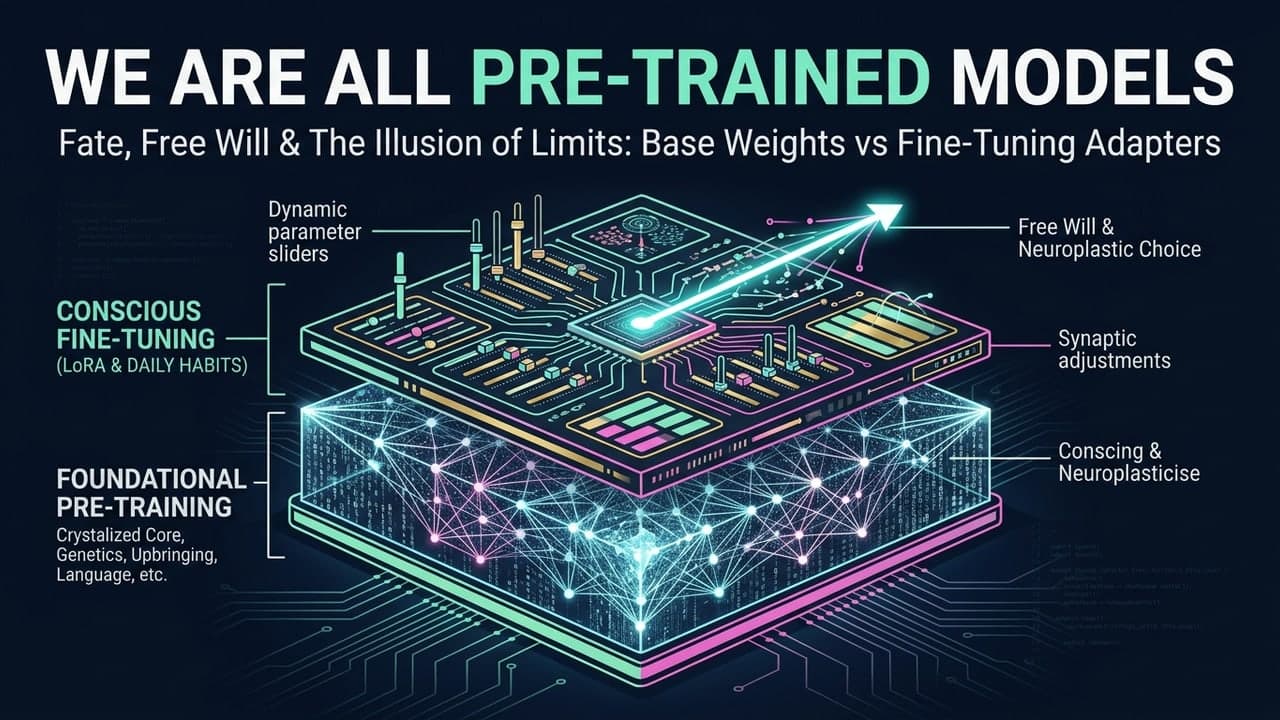
To understand human existence through the lens of modern computation is to abandon the comforting myth of the tabula rasa (the psychological theory that individuals are born without built-in mental content and that therefore all knowledge comes from experience or perception). Just as a modern Large Language Model (LLM)—such as GPT-4 or Gemini—does not wake up in a vacuum of ignorance, a human infant enters the world having undergone a massive, multi-billion-year pre-training phase. This initialization process spans evolutionary biology, structural linguistics, and epigenetic cultural transmission.
The Genetic Code as Foundational Training Data
From a machine learning perspective, DNA is the ultimate base-layer pre-training corpus. Sculpted by billions of years of natural selection (the evolutionary equivalent of stochastic gradient descent operating on population-scale feedback loops), our genetic code instantiates deeply ingrained prior probabilities. These priors dictate everything from basic metabolic pathways to complex behavioral predispositions—fear responses to perceived threats, social bonding mechanisms, and neurochemical reward systems.
# Conceptualizing human initialization via genetic and cultural priors
class HumanPreTrainedModel:
    def __init__(self, species_dna_weights, cultural_tokenizer):
        # Evolutionary priors baked into the architecture
        self.weights = self.load_evolutionary_priors(species_dna_weights)
        # Linguistic and historical context window initialization
        self.tokenizer = cultural_tokenizer
        self.context_window_limit = 7  # Miller's Law approximation for working memory

    def load_evolutionary_priors(self, dna):
        # Hardcoded survival heuristics, innate fears, and drive states
        return {
            "fight_or_flight": dna.get("amygdala_sensitivity", 0.8),
            "social_cohesion": dna.get("oxytocin_baseline", 0.7),
            "novelty_seeking": dna.get("dopaminergic_tone", 0.5)
        }
Just as an LLM initializes its attention heads and multilayer perceptron weights to recognize syntax and semantic structures before reading a single prompt, humans are born with a heavily parameterized cognitive architecture. We do not learn how to fear a predator or how to parse human facial expressions from a blank slate; those pathways are pre-compiled.
Linguistic Structures and the Universal Grammar
Noam Chomsky’s theory of Universal Grammar posits that the human brain contains an innate, genetically determined blueprint for language. In machine learning terms, humans possess an architectural inductive bias (the set of assumptions that a model uses to predict outputs for unseen inputs). We are not designed to learn any arbitrary mapping of symbols to meanings with equal ease; we are explicitly optimized to parse recursive, hierarchical linguistic structures.
[Evolutionary Optimization (Billions of Years)]
       ↓ produces
[Innate Architectural Priors (DNA / Universal Grammar)]
       ↓ initializes
[Cultural & Historical Context (Societal Tokenization)]
       ↓ yields
[The Initialized Human Agent ready for Fine-Tuning]
When an infant is born into a specific linguistic and cultural ecosystem, it does not invent language; it selects the specific vocabulary and morphological rules of its local token space, mapping them onto a pre-existing linguistic decoder ring.
Fine-Tuning Our Weights: The Mechanics of Choice, Experience, and Adaptation
Once initialization is complete, the continuous cycle of human life mirrors the fine-tuning phase of machine learning models. We interact with our environment, receive continuous loss signals (pain, social rejection, joy, failure), and adjust our internal weights accordingly.
The Daily Update Cycle: Neuroplasticity as Gradient Updates
Human neuroplasticity—the ability of synapses to strengthen or weaken over time in response to experience—is biological backpropagation (the algorithmic process of calculating gradients and adjusting network weights to minimize prediction error). When a human child touches a hot stove or experiences public humiliation, the brain registers a high prediction error, colloquially known as loss. Neurotransmitters like dopamine and norepinephrine act as learning rate modulators, telling local neural circuits to update their synaptic weights so that the negative outcome is less likely to be repeated.
class HumanAgent:
    def __init__(self, initial_weights):
        self.weights = initial_weights
        self.learning_rate = 0.01

    def experience_event(self, context, actual_outcome, desired_outcome):
        # Calculate cognitive/emotional prediction error (Loss)
        prediction_error = abs(desired_outcome - actual_outcome)

        # Backpropagation-style weight adjustment (Neuroplasticity)
        if prediction_error > 0.5:
            self.adjust_weights(context, prediction_error)

    def adjust_weights(self, context, error):
        for key in self.weights:
            # Synaptic scaling based on experience
            self.weights[key] -= self.learning_rate * error * self.weights[key]
Constrained Optimization vs. Tabula Rasa Agency
The popular conception of free will implies an unconstrained agent sitting outside its history, capable of making entirely unconditioned choices at any given moment. Modern neuroscience and machine learning dismantle this illusion, replacing it with the framework of constrained optimization (the mathematical process of finding the best solution from a set of available choices where certain constraints must be satisfied).
An individual's choice in any given scenario is the output of a deterministic function applied to their current state vector, modulated by stochastic noise (randomness injected into a system, such as quantum fluctuations at the synaptic level or internal biochemical variance).
| Feature | Tabula Rasa Agency (Illusion) | Constrained Optimization (Reality) |
|---|---|---|
| Origin of Choice | Spontaneous, uncaused, absolute will | Deterministic function of history and weights |
| Role of Environment | Passive backdrop | Active prompt-engineering engine |
| Impact of Biology | Minimal or non-existent | Foundational architectural priors |
| Debate Context | Classic libertarian philosophy | Neurocomputational synthesis |
True unconditioned agency is mathematically impossible. Every decision is a continuation of the loss function optimized by the organism up to that exact microsecond. Exploring free will and determinism through this computational lens transforms how we evaluate personal accountability and moral responsibility.
In the Wild: Living and Prompting Inside Complex Societal Environments
Human beings do not exist in isolation; they are deployed "in the wild," constantly bombarded by external prompts, contextual frames, and feedback loops engineered by both society and advanced technologies.
The Autocomplete Life: Algorithms and Cultural Echo Chambers
Modern life exposes human pre-trained models to continuous automated prompting. Recommendation engines, social media algorithms, and cultural echo chambers function as external prompt-engineering suites. They curate the context window of the human mind, feeding it hyper-optimized inputs designed to trigger specific, predictable generations (outrage, compliance, consumption).
When an individual spends hours scrolling through polarized content, the algorithm is performing in-context learning amplification, steering the human model toward specific regions of its latent space (a multi-dimensional mathematical space where concepts and features are represented as coordinates). We often mistake these externally driven trajectories for our own authentic volition.
Context Windows and Attention Spans
Just as an LLM has a finite context window (the maximum number of tokens a model can process or remember in a single prompt) beyond which information is forgotten or pushed out of active memory, human working memory is notoriously constrained (historically measured as 7 ± 2 items, though modern cognitive science places it even lower).
class HumanContextWindow:
    def __init__(self, max_tokens=7):
        self.active_memory = []

    def receive_prompt(self, environmental_stimulus):
        self.active_memory.append(environmental_stimulus)
        if len(self.active_memory) > self.max_tokens:
            # Information drops out of the immediate attention span
            self.active_memory.pop(0)

    def generate_thought(self):
        # Outputs are strictly conditioned on what remains in the active context
        return f"Processing immediate state based on: {self.active_memory}"
This limitation has profound implications: our immediate environment dictates which parts of our internal "model" we actually activate. If your current room is stressful, noisy, or filled with specific cues, those tokens dominate your context window, crowding out long-term values, deep ethical commitments, and historical wisdom. You become a creature of your immediate prompt.
Hallucination and Creativity
In artificial intelligence, a hallucination occurs when a model generates fluent, confident, but factually incorrect outputs because it is extrapolating beyond its training distribution or over-weighting unlikely token associations.
In human cognition, hallucination and creativity are two sides of the same coin. Artistic invention, scientific breakthroughs, and psychotic delusions all stem from the same neural mechanism: combinatorial extrapolation across a latent space. When the brain synthesizes novel ideas that have never existed before, it is sampling from the probability distributions of its pre-trained existence, blending disparate concepts in ways that sometimes map to objective reality (creativity) and sometimes fracture away from it (hallucination).
Decoding the Latent Space: Determinism, Autoregressive Futures, and Emergence
To reconcile human lived experience with computational reality, we must examine the nature of human potential through machine learning paradigms.
Hard Determinism, Compatibilism, and Stochastic Freedom
- Hard Determinism: The philosophical view that all events, including human actions, are ultimately determined by causes external to the will—or, in computational terms, that given a specific set of initial parameters and an incoming prompt, the output of the human model is entirely fixed.
- Stochastic Freedom: The inclusion of random noise (quantum-level neural indeterminacy, chaotic micro-fluctuations) that ensures even identical models with identical weights will diverge slightly in their outputs.
- Compatibilism: The belief that free will and determinism are compatible ideas, recognizing that even if our choices are causally determined by our weights and prompts, we still possess agency in the sense that our internal deliberative loops are active participants in generating the output.
[Input Prompt] + [Internal Weights (DNA + Experience)] + [Stochastic Noise]
       ↓
[Autoregressive Generation (Step-by-Step Thought Process)]
       ↓
[Final Action / Choice]
Mapping the Latent Space of Human Potential
The latent space of human potential is a high-dimensional mathematical manifold where every possible thought, behavior, belief, and lifestyle is mapped as a coordinate.
Are we doomed to follow the path of least resistance (the valleys of high probability)? Yes, unless external energy (deliberate friction, mindfulness, radical environment redesign) is introduced. Moving across the latent space requires energy. Without conscious intervention, the autoregressive nature of human thought naturally drifts toward the nearest attractor states (habits, biases, cultural defaults). This delicate balance between free will and determinism defines the boundary of human capability.
Rewriting the Loss Function: Finding Meaning in a Pre-Trained Existence
Discovering that absolute, unconditioned free will is a mathematical fiction can initially feel destabilizing—the existential dread of realizing you are an autoregressive model executing code written by evolution and society. However, this realization offers a profound path toward liberation.
Redefining Autonomy and Responsibility
Autonomy is not the magical ability to act without cause; it is the meta-cognitive capacity to inspect your own weights, monitor your own loss function, and actively modify your environment to change your future prompts.
class ConsciousModelAgent:
    def __init__(self, weights):
        self.weights = weights

    def meta_cognition(self):
        # Inspecting one's own behavioral biases and parameters
        current_biases = self.evaluate_weights()
        if self.detects_malfunctional_bias(current_biases):
            self.rewrite_loss_function()

    def rewrite_loss_function(self):
        # Deliberately changing what the agent optimizes for
        print("Recalibrating fundamental life objectives...")
        self.weights["empathy"] *= 1.5
        self.weights["reactivity"] *= 0.5
Embracing Our Parameters to Build Conscious Futures
When we accept that we are pre-trained models, we stop wasting energy trying to achieve an impossible, unconditioned purity of will. Instead, we engage in deliberate engineering:
- Curating Our Training Data: Choosing what media, books, conversations, and communities we expose ourselves to, recognizing that every input updates our weights.
- Optimizing Context Windows: Designing physical and digital environments that prevent toxic prompts from dominating our active attention span.
- Redefining Our Loss Functions: Consciously selecting the values—compassion, curiosity, creation, and resilience—that our daily actions optimize for.
We may be pre-trained models, but we are models with a rare and recursive feature: we can read our own code, rewrite our loss functions, and actively participate in the next epoch of our evolution. Understanding the intricate dance of free will and determinism allows us to stop fighting our architecture and start programming our destiny.