Note on Transparency: This article was generated with the assistance of Artificial Intelligence to provide a comprehensive and up-to-date overview of the discussed topic.
The Shifting Sands of Enterprise Intelligence: A Call for Digital Sovereignty
The AI revolution is here, transforming how businesses operate, innovate, and compete. From automating mundane tasks to unearthing profound insights from vast datasets, Artificial Intelligence promises unprecedented efficiency. Yet, beneath this shimmering surface of opportunity lies an unseen peril, especially for enterprises wrestling with sensitive data: the inherent conflict between the promise of cloud AI and the stark realities of enterprise data security.
For years, the default mode for leveraging cutting-edge AI has been through cloud-based services. These platforms offer incredible computational power and readily available models, but they come with a hidden cost: your data must leave your controlled environment. It journeys across the internet, residing on third-party servers, processed by systems whose internal workings are often opaque. For many organizations, particularly those in highly regulated industries like healthcare, finance, or government, this data exodus is simply not an option. The potential for breaches, compliance nightmares, and the erosion of intellectual property is too great.
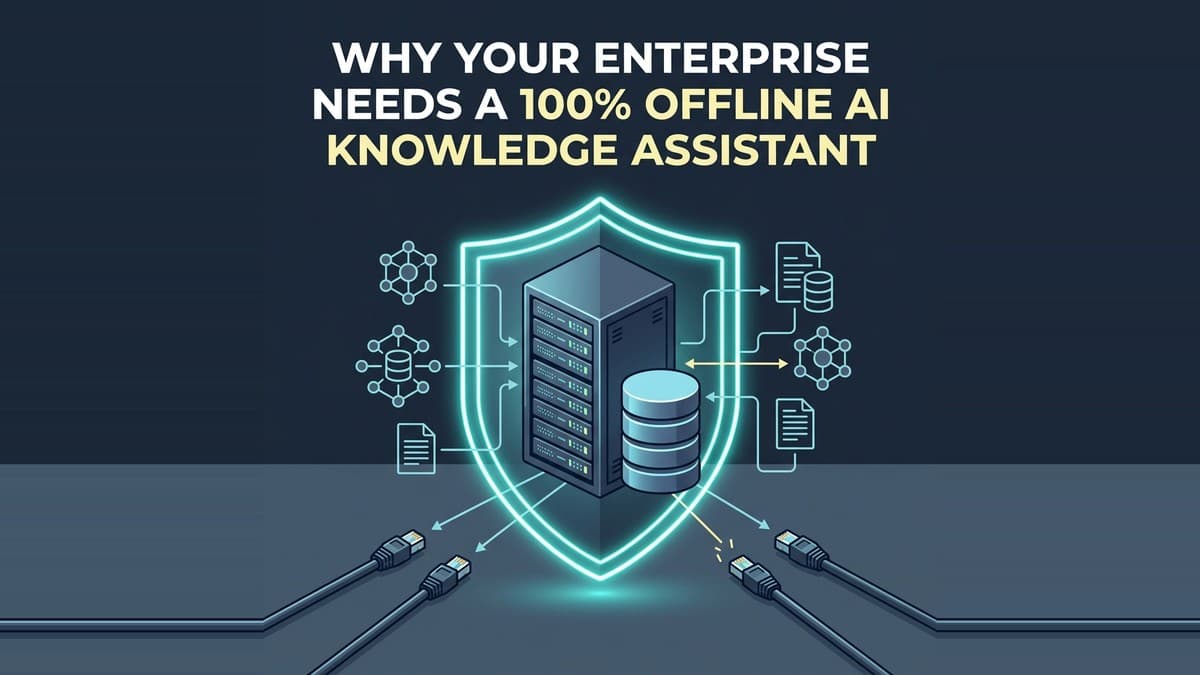
This is where the paradigm shifts. Imagine the power of AI, fully unleashed, yet entirely contained within your organization's digital walls. This is the promise and reality of the 100% offline AI knowledge assistant. It's a strategic move towards digital sovereignty, ensuring that your most valuable asset—your data—never compromises its integrity or privacy, even as you harness the full transformative power of AI.
Unpacking "Offline AI": The Pillars of Air-Gapped Enterprise Knowledge
When we talk about "100% offline AI," we're not just referring to an internet connection that's occasionally down. We're talking about true isolation—a system designed from the ground up to operate without any external calls, any data egress, or any reliance on third-party cloud services. Think of it like a digital vault: your sensitive information goes in, and it never, ever leaves. This ensures that no data "phones home" to vendors, no API calls traverse the public internet, and your confidential information remains firmly within your enterprise's physical or logical perimeter.
The Architecture of Autonomy
Achieving this level of autonomy requires a carefully constructed architecture. At its heart, an offline AI knowledge base leverages several key components, all running within your secure environment:
- Leveraging Local Large Language Models (LLMs) and Embedded Vector Databases: The magic starts with bringing the intelligence inside. Instead of querying a gigantic LLM hosted by OpenAI or Google, an offline solution uses local Large Language Models (LLMs). These are powerful AI models, often optimized for on-device inference, that perform natural language understanding and generation directly on your internal servers. They can answer questions, summarize documents, and generate text without ever touching the public internet.
To make these LLMs truly useful for an enterprise, they need access to your specific knowledge. This is where embedded vector databases come in. These specialized databases store your enterprise documents, reports, and data as numerical representations called "vectors." When a user asks a question, the vector database quickly finds the most relevant pieces of information from your private stores, enabling the LLM to provide accurate, context-aware answers.
    # This is a conceptual example demonstrating local LLM inference and embeddings.
    # Actual implementation often uses projects like llama.cpp for efficiency.

    from llama_cpp import Llama

    # Initialize LLM for local inference.
    # The 'local_model.gguf' would be a GGUF format model (e.g., Llama 2, Mistral)
    # converted for efficient local execution using tools like llama.cpp.
    # If built with embedding support (via --sentence-transformers-dense-modules flag
    # during conversion and server run with --embedding), it can also generate embeddings.
    try:
        llm = Llama(model_path="./local_model.gguf", n_ctx=2048) # n_ctx for context window size
        print("Local LLM loaded successfully for inference.")

        # Example of local text generation (no internet required)
        prompt = "Q: What are the key compliance regulations for financial data in Europe? A:"
        response = llm(prompt, max_tokens=128, stop=["Q:", "\n"], echo=False)
        print(f"\nLLM Response (local inference): {response['choices'][0]['text'].strip()}")

        # Conceptual example for generating embeddings for a document chunk
        # In a real setup, this might be a separate call to an embedding-enabled llama.cpp server
        # or a function if the client library exposes it directly.
        doc_chunk = "The General Data Protection Regulation (GDPR) is a comprehensive data privacy law."
        # If the Llama object supports it directly, it might look like:
        # embeddings = llm.create_embedding(input=[doc_chunk])
        # print(f"\nConceptual Embeddings for '{doc_chunk[:30]}...': {embeddings[:5]}...") # Display first 5 values
        print(f"\n(In a full **offline AI knowledge base** setup, embeddings for '{doc_chunk[:30]}...' would be generated locally and stored in a vector database.)")

    except Exception as e:
        print(f"Failed to load local LLM or perform inference: {e}")
        print("Ensure 'local_model.gguf' exists and llama-cpp-python is installed with necessary bindings.")
The
llama.cppproject, a cornerstone for efficient local LLM inference, is a prime example of technology enabling this autonomy. When models are converted with flags like--sentence-transformers-dense-modules, they can even generate document embeddings directly on your hardware, eliminating yet another external dependency.
-
Crafting Private RAG Pipelines: At the core of a robust offline AI knowledge base is a Retrieval Augmented Generation (RAG) pipeline that lives entirely within your perimeter. This means when an LLM needs to answer a question, it retrieves information only from your internal, air-gapped data sources (stored in your vector database). This critical step prevents the LLM from "hallucinating" or pulling information from the internet, ensuring answers are always grounded in your secure, proprietary knowledge.
-
Ensuring End-to-End Data Flow Stays On-Premise: From the moment your data is ingested and indexed, through its conversion into vectors, to the LLM's processing and the final response generation—every single step of the data lifecycle occurs within your enterprise's own infrastructure. There are no external data transfer points, no third-party APIs involved, just pure, self-contained intelligence.
[!TIP] Production-Ready Reference: For an enterprise-ready, open-source implementation of a 100% offline knowledge assistant, check out the KnowledgeHub AI GitHub Repository. It provides a full, self-hosted blueprint using FastAPI and React/Vite that runs completely local, incorporating advanced document chunking, hybrid retrieval (FAISS semantic search + BM25 keyword matching), and Role-Based Access Control.
Beyond Security: Driving Compliance, Data Control, and IP Protection
The benefits of offline AI extend far beyond mere security. It’s about fundamental control and strategic advantage:
-
Navigating Regulatory Landscapes: For enterprises grappling with stringent regulations like GDPR, HIPAA, FINRA, and others, an offline AI dramatically simplifies compliance. By ensuring sensitive data never leaves your controlled environment, you effortlessly address data residency requirements and significantly ease the burden of demonstrating privacy adherence.
-
Reclaiming Full Control Over Proprietary and Sensitive Information: When you operate AI systems entirely on-premise, you regain complete ownership and control over your proprietary data. This prevents unauthorized access, safeguards against inadvertent exposure to third parties, and eliminates the risk of your valuable information being used to train external models.
-
The Strategic Advantage of Uncompromised Data Sovereignty: In an era where data is the new oil, maintaining absolute data sovereignty is a profound strategic advantage. It protects your intellectual property, fortifies critical business insights, fosters unparalleled trust with clients, and significantly reduces legal and reputational risks associated with data breaches. This uncompromised control is what empowers your organization to innovate securely.
Cloud vs. Cordoned: A Strategic Comparison of Enterprise AI Pathways
Choosing the right AI pathway is a pivotal strategic decision for any enterprise. Let's pit the traditional cloud-based AI approach against the self-contained power of an offline AI knowledge base.
| Feature | Cloud-Based AI | Offline AI Knowledge Base |
|---|---|---|
| Security & Privacy | Shared Responsibility Model: Enterprise accountable for data in the cloud; inherent third-party vulnerabilities & risks. Data egress. | Absolute Data Isolation: Enterprise maintains full control over infrastructure & data. Eliminates third-party security risks. No data leaves perimeter. |
| Compliance & Auditability | Complex Jurisdictions: Challenges with data residency across global regions; opaque data flows through external services. | Simplified Compliance: All data within a single, controlled environment; transparent internal audits; easier regulatory adherence. |
| Performance & Dependability | Network Latency & Throttling: Performance dependent on internet speed & API limits; external service dependencies can cause downtime. | Local Processing Speeds: Superior speed, uninterrupted access; resilient against external network issues or service disruptions. |
| Cost Implications | Hidden Costs: Data egress fees, per-API call charges, potential vendor lock-in; unpredictable total cost of ownership. | Predictable On-Premise Costs: Clear investment in internal infrastructure; transparent long-term financial outlook; no surprise cloud bills. |
| Innovation & Customization | Vendor Constraints: Limited by vendor roadmaps, service offerings, restrictive data sharing agreements; less room for bespoke solutions. | Full Freedom: Iterate, fine-tune models with specific data; develop highly customized & proprietary AI solutions without external constraints. |
This table clearly illustrates a fundamental trade-off. While cloud AI offers convenience, it often comes at the expense of control, predictability, and ultimate security. For mission-critical data and applications, the
offline AI knowledge basepresents a compelling, and often superior, alternative.
Igniting Productivity, Securing Insight: Real-World Applications in the Air Gap
The true power of a 100% offline AI knowledge base shines through in its real-world applications across diverse, sensitive industries. Here, secure insight generation directly translates into enhanced productivity and fortified data integrity.
Healthcare
In healthcare, the stakes are incredibly high. An offline AI can securely process Electronic Health Records (EHRs) for diagnostic support, assist in accelerating secure medical research by analyzing vast datasets of anonymized or pseudonymized patient data, and streamline compliance queries related to regulations like HIPAA. Doctors and researchers can interrogate an internal knowledge base of medical literature, patient histories, and drug interactions, receiving rapid, accurate, and, most importantly, private insights that never leave the hospital's secure network. This protects patient privacy while empowering medical professionals.
Financial Services
Financial institutions are constantly under pressure to maintain robust security and adhere to strict regulatory guidelines. An offline AI fortifies fraud detection by analyzing internal transaction patterns in real-time, ensures regulatory reporting integrity by cross-referencing against internal compliance documents, and powers private investment analysis without external exposure. Analysts can securely query proprietary market data, internal risk models, and client portfolios, making informed decisions while safeguarding sensitive financial information and adhering to FINRA regulations.
Government & Defense
For government and defense agencies, national security is paramount. An air-gapped AI solution is indispensable for analyzing classified documents, enhancing secure intelligence gathering by sifting through vast quantities of secure internal data, and safeguarding critical operational planning. This allows analysts to process highly sensitive information within secure, isolated environments, eliminating any risk of data leakage or unauthorized access—a capability that is non-negotiable for national security operations.
Manufacturing & Engineering
In manufacturing and engineering, intellectual property (IP) is the lifeblood of innovation. An offline AI defends this IP by securely analyzing design specifications, R&D notes, and proprietary processes. Engineers can interrogate internal CAD files, simulation results, and material science databases to optimize designs or troubleshoot issues, all without exposing valuable trade secrets to external threats. This ensures that groundbreaking innovations remain within the company's competitive advantage.
Legal & Professional Services
Legal and professional services firms handle some of the most sensitive client data imaginable. An offline AI can securely interrogate client-confidential legal documents, internal knowledge bases of case law, and proprietary research without ever compromising client confidentiality. This enables legal teams to rapidly find precedents, summarize complex contracts, and generate insights from vast amounts of private information, providing unparalleled service while maintaining the highest ethical standards of data privacy.
The Future is Private: Embracing Secure, Self-Contained AI for Competitive Advantage
The advent of accessible, powerful local AI technologies fundamentally recalibrates the risk-reward equation for enterprise AI adoption. For too long, organizations have had to choose between cutting-edge AI capabilities and unwavering data security. The choice often meant compromising one for the other, particularly for those with the most sensitive data. However, the rise of the 100% offline AI knowledge assistant eliminates this false dichotomy.
This self-contained intelligence is not merely a security measure; it is a profound strategic asset. It empowers enterprises to leverage the full potential of AI without the fear of data breaches, compliance violations, or intellectual property theft. By investing in an offline AI knowledge base, organizations are not just buying technology; they are investing in unparalleled data sovereignty, fostering deeper trust with their clients and partners, and building an enduring competitive advantage in an increasingly data-sensitive world.
Embracing secure, self-contained AI allows enterprises to accelerate innovation, fine-tune models with their unique, proprietary datasets, and develop bespoke solutions perfectly tailored to their specific challenges, all while operating with complete peace of mind. The future of enterprise AI is here, and it's private, powerful, and entirely within your control. If you're ready to start building your own offline AI capability, exploring production-grade codebases like KnowledgeHub AI is an excellent way to fast-track your development journey securely.