Note on Transparency: This article was generated with the assistance of Artificial Intelligence to provide a comprehensive and up-to-date overview of the discussed topic.
Table of Contents
-
The Electric Architecture of Mind
- Unpacking the biological hardware of cognition
- From static synapses to dynamic cascades: How neural activations and thoughts intertwine
- The threshold of experience: When sub-threshold impulses ignite into conscious awareness
-
The Topology of an Idea: Pathways, Weights, and Attractors
- How recurrent loops and neural highways shape recurring mental patterns
- Hebbian learning in action: "Cells that fire together, wire together"
- Navigating cognitive landscapes: Why some mental paths become deep valleys while others remain untamed brush
-
Currents in the Wild: Modern Manifestations of Neural Dynamics
- Artificial neural networks and the silicon emulation of human cognition
- Brain-computer interfaces (BCIs): Translating raw activations into real-world action
- Neurofeedback and cognitive training: Deliberately steering the brain's electrical currents
-
Biological Hardware vs. Silicon Simulation: A Comparative Anatomy of Activation
- Wetware versus software: Comparing biological neural circuits with deep learning architectures
- Energy efficiency, parallel processing, and the nature of emergent intelligence
- Deterministic paths versus stochastic leaps: How human thought outpaces current computation
-
Architects of Our Own Circuits
- The profound responsibility of mental habituation
- Redesigning cognitive pathways through intentional focus and neuroplasticity
- Concluding thoughts on the frontier of mind, matter, and motion
The Electric Architecture of Mind
Unpacking the Biological Hardware of Cognition
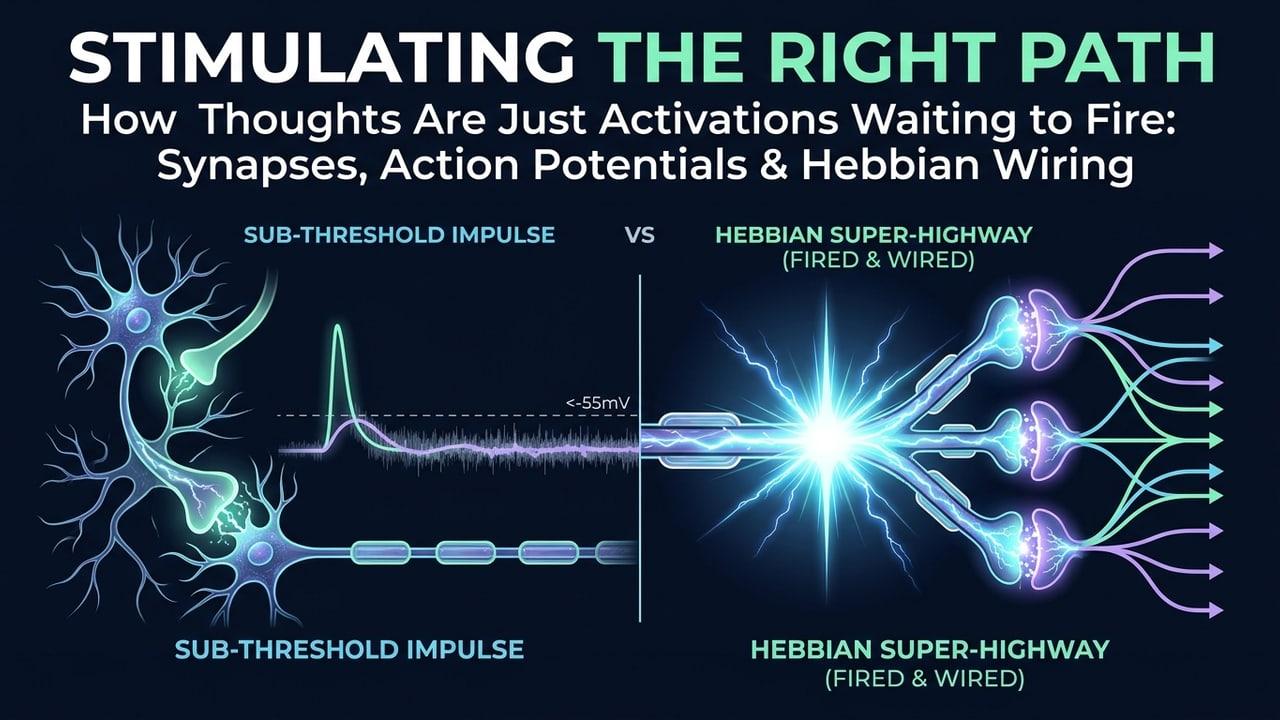
At the fundamental micro-scale of human experience, the brain is an electrochemical organ comprising approximately 86 billion neurons, each connected to thousands of others via synapses, creating a web of roughly 100 trillion connections. The biological hardware of cognition relies on the modulation of electrical potential across cellular membranes. In its resting state, a neuron maintains a negative internal polarization—known as the resting membrane potential—typically around -70 mV. This polarization is actively sustained by sodium-potassium pumps (Na⁺/K⁺-ATPase), which pump three Na⁺ ions out for every two K⁺ ions brought in.
Cognition begins when chemical neurotransmitters (such as glutamate or gamma-aminobutyric acid [GABA]) bind to postsynaptic receptors, inducing graded potentials. If these incoming signals sufficiently depolarize the membrane to reach a critical threshold (typically around -55 mV), voltage-gated sodium channels open rapidly, triggering an action potential—a transient, all-or-none electrical impulse that propagates down the axon without attenuation.
From Static Synapses to Dynamic Cascades: How Neural Activations and Thoughts Intertwine
A single action potential is meaningless in isolation; thoughts emerge from dynamic cascades of synchronous and sequential firing across distributed neural networks. When a stimulus or internal memory cue occurs, it initiates a spatiotemporal pattern of activation.
As specific assemblies fire, they recruit interconnected populations through feedforward and feedback projections. This recruitment transforms static structural anatomy into a living, shifting landscape of electrical activity. Working memory, for instance, is sustained not by structural changes alone, but by persistent, dynamic reverberations within frontoparietal networks. Understanding how neural activations and thoughts intertwine allows us to view everyday cognition not as a static library of facts, but as a continuous, flowing symphony of electrical currents.
The Threshold of Experience: When Sub-Threshold Impulses Ignite into Conscious Awareness
The brain is constantly bombarded with sub-threshold impulses—sensory noise, background metabolic fluctuations, and sub-liminal cues—that fail to trigger a systemic response. According to the Global Neuronal Workspace Theory (GNWT), a thought or percept crosses the threshold into conscious awareness only when it ignites a widespread, non-linear synchronization across distant brain regions (particularly prefrontal and parietal cortices).
Below this ignition threshold, information remains processed unconsciously in localized modular circuits. Once the cumulative activation breaches the global threshold, a phase transition occurs: a widespread, sustained ignition pattern that broadcasts the signal globally, rendering it accessible to introspection, verbal report, and deliberate action.
The Topology of an Idea: Pathways, Weights, and Attractors
How Recurrent Loops and Neural Highways Shape Recurring Mental Patterns
Neural architectures are heavily populated by recurrent connections—loops where downstream neurons project back to upstream or recurrent targets. These loops allow the brain to maintain historical context, perform temporal integration, and form stable recurring mental patterns (habits, core beliefs, and automated motor sequences).
From a dynamical systems perspective, these neural highways form attractor states. An attractor is a state or set of states toward which a dynamical system tends to evolve over time. In the brain, an attractor basin represents an idea, concept, or memory. When an input pushes the system near the rim of a basin, the network's internal dynamics naturally pull the activation state down into the center of the basin, stabilizing the thought or pattern.
Hebbian Learning in Action: "Cells That Fire Together, Wire Together"
Donald Hebb’s 1949 postulate—"Cells that fire together, wire together"—provides the microscopic mechanism by which these topological landscapes are carved. At the molecular level, this is actualized through Long-Term Potentiation (LTP), most notably studied at glutamatergic synapses involving NMDA (N-methyl-D-aspartate) receptors.
When presynaptic release of glutamate coincides with strong postsynaptic depolarization, Mg²⁺ blocks are expelled from the NMDA receptor channel pore, permitting an influx of calcium (Ca²⁺) ions. This calcium surge activates protein kinases (such as CaMKII and PKC), leading to the insertion of additional AMPA receptors into the postsynaptic membrane and retrograde signaling that enhances presynaptic neurotransmitter release.
[Presynaptic Neuron]
       │ (Glutamate Release)
       ▼
[Postsynaptic NMDA Receptor] + [Strong Depolarization]
       │ (Mg2+ Ion Unblocks Pore)
       ▼
[Ca2+ Influx] ──► [Activation of CaMKII / PKC]
       │
       ├─► Upregulation & Insertion of AMPA Receptors
       └─► Retrograde Messengers ──► Enhanced Presynaptic Release
       *(Long-Term Potentiation / Hebbian Wiring Established)*
Navigating Cognitive Landscapes: Why Some Mental Paths Become Deep Valleys While Others Remain Untamed Brush
Because of LTP and its counterpart, Long-Term Depression (LTD), frequent thoughts act like water flowing down a hillside. Each traversal deepens the channel (attractor basin). Consequently, trauma-induced anxiety loops, chronic worry, or deeply practiced skills become deep, steep-sided valleys that require minimal energy to fall into.
Conversely, novel perspectives, creative solutions, or unfamiliar behavioral changes represent "untamed brush"—pathways with low synaptic weights that require high conscious effort and metabolic activation to navigate. Each time we focus our attention, we reinforce specific neural activations and thoughts, turning overgrown brush into well-paved mental highways.
Currents in the Wild: Modern Manifestations of Neural Dynamics
Artificial Neural Networks and the Silicon Emulation of Human Cognition
Artificial intelligence directly borrows its foundational architecture from biological neural dynamics. An artificial neuron (perceptron) computes a weighted sum of its inputs, adds a bias, and passes the result through an activation function (such as ReLU or Sigmoid):
y = f( Σ(i=1 to n) wᵢxᵢ + b )
In deep learning, training via backpropagation adjusts the weights (wᵢ) based on gradient descent—serving as a silicon analogue to Hebbian plasticity and synaptic weight adjustment. Modern architectures like Transformers utilize self-attention mechanisms to dynamically weigh the importance of different tokens in a sequence, emulating how biological attention focuses neural currents across distributed memory traces.
Brain-Computer Interfaces (BCIs): Translating Raw Activations into Real-World Action
Brain-computer interfaces bypass traditional neuromuscular pathways by reading raw electrical activations directly from the brain and translating them into external device commands. Invasive systems (such as Neuralink or Utah Array deployments) use microelectrode arrays implanted directly into the motor cortex to record single-unit action potentials and local field potentials (LFPs).
Using real-world decoding algorithms, such as Kalman filters or deep recurrent neural networks, these systems map neural firing rates to cursor movements, robotic limb actuation, or speech synthesizer outputs.
import numpy as np

def decode_neural_intent(spike_trains, decoder_weights, bias):
    """
    Decodes raw neural spike trains into kinematic movement vectors (e.g., 2D velocity).

    Parameters:
    - spike_trains: numpy array of shape (n_channels, time_bins) containing firing rates.
    - decoder_weights: learned linear filter weights of shape (2, n_channels)
    - bias: velocity bias vector of shape (2,)

    Returns:
    - velocity_vector: predicted 2D movement vector [vx, vy]
    """
    # Compute mean firing rate across the immediate time window for each channel
    mean_rates = np.mean(spike_trains, axis=1)

    # Linear kinematic decoding transformation
    velocity_vector = np.dot(decoder_weights, mean_rates) + bias
    return velocity_vector

# Example Simulation
n_channels = 128
time_bins = 50
simulated_spikes = np.random.poisson(lam=15.0, size=(n_channels, time_bins))
weights = np.random.randn(2, n_channels) * 0.05
bias_term = np.array([0.1, -0.05])

predicted_velocity = decode_neural_intent(simulated_spikes, weights, bias_term)
print("Decoded Movement Vector [vx, vy]:", predicted_velocity)
Neurofeedback and Cognitive Training: Deliberately Steering the Brain's Electrical Currents
Neurofeedback uses real-time displays of electroencephalography (EEG), functional magnetic resonance imaging (fMRI), or magnetoencephalography (MEG) to provide individuals with immediate audiovisual feedback on their brainwave activity. By operant conditioning, subjects learn to consciously alter their own brain electrical states—such as up-regulating SMR (sensorimotor rhythm) or alpha waves to enhance focus or reduce anxiety. This proves that conscious intention can intentionally modulate the topological currents of the mind.
Biological Hardware vs. Silicon Simulation: A Comparative Anatomy of Activation
Wetware versus Software: Comparing Biological Neural Circuits with Deep Learning Architectures
While deep learning models achieve remarkable computational feats, their underlying mechanics diverge significantly from biological wetware:
| Metric / Feature | Biological Neural Networks (Wetware) | Artificial Neural Networks (Silicon) |
|---|---|---|
| Substrate | Ions (Na⁺, K⁺, Ca²⁺, Cl⁻) across lipid membranes | Silicon transistors, binary digital logic |
| Signal Transmission | Electrochemical, continuous-time, variable spike-timing | Synchronous matrix multiplications, discrete floating-point tensors |
| Learning Paradigm | Local rules (Hebbian LTP/LTD, neuromodulation) | Global error backpropagation and gradient descent |
| Topology | Highly recurrent, 3D, complex sparse wiring | Typically layered feedforward or structured blocks (e.g., Transformers) |
Energy Efficiency, Parallel Processing, and the Nature of Emergent Intelligence
The human brain operates on an astonishingly modest power budget of roughly 20 Watts—less than a dim incandescent light bulb—while performing complex multisensory integration, self-awareness, and real-world adaptation. In contrast, training state-of-the-art Large Language Models requires megawatts of power and massive server clusters.
Biology achieves this through radical mass parallelism and asynchronous, event-driven processing (spiking neurons only consume significant metabolic energy when firing action potentials). Intelligence in biology is a true emergent property of decentralized, self-organizing homeostatic loops, whereas silicon intelligence remains structurally dependent on centralized algorithmic optimization.
Deterministic Paths Versus Stochastic Leaps: How Human Thought Outpaces Current Computation
Biological brains are intrinsically noisy stochastic systems. Thermal fluctuations, stochastic ion channel gating, and random neurotransmitter vesicle release introduce noise into neural circuits. Far from being a flaw, this stochasticity prevents neural networks from getting trapped in rigid local minima, enabling creative leaps, probabilistic reasoning, and out-of-distribution generalization that deterministic digital architectures often struggle to replicate without heavy prompt engineering or temperature adjustments.
Architects of Our Own Circuits
The Profound Responsibility of Mental Habituation
Because of Hebbian learning and neuroplasticity, what we repeatedly think, feel, and focus on physically restructures our brain. Every mental state becomes a structural trait over time.
If an individual chronically stokes pathways of grievance, catastrophic worry, or self-doubt, they reinforce those deep attractor valleys, making negative emotional loops the default biological path. Conversely, redirecting attention toward gratitude, focused problem-solving, or calm observation carves new, life-affirming highways within our internal landscape.
Redesigning Cognitive Pathways Through Intentional Focus and Neuroplasticity
Neuroplasticity is not passive; it requires attention and novelty to trigger neuromodulatory gates. The release of acetylcholine from the basal forebrain and dopamine from the ventral tegmental area act as biological markers that tag specific synapses for structural modification during focused engagement.
By practicing metacognition—observing the arrival of an automatic negative thought without immediately identifying with it or feeding it—an individual starves the old attractor basin of metabolic reinforcement. Simultaneously, consciously choosing an alternative cognitive appraisal activates a nascent pathway, building new structural synapses through deliberate neuroplasticity.
Concluding Thoughts on the Frontier of Mind, Matter, and Motion
We are not merely passive observers trapped inside a fixed biological cage; we are the active architects of our own neural circuitry. Thoughts are neither ephemeral ghosts nor static data points—they are dynamic electrochemical activations waiting to fire, flowing across landscapes carved by our past choices.
Understanding the electrical architecture of the mind reveals a profound truth: by deliberately steering our attention and mastering our mental currents, we hold the biological power to reshape our neural topologies, transforming how we experience reality itself.