Note on Transparency: This article was generated with the assistance of Artificial Intelligence to provide a comprehensive and up-to-date overview of the discussed topic.
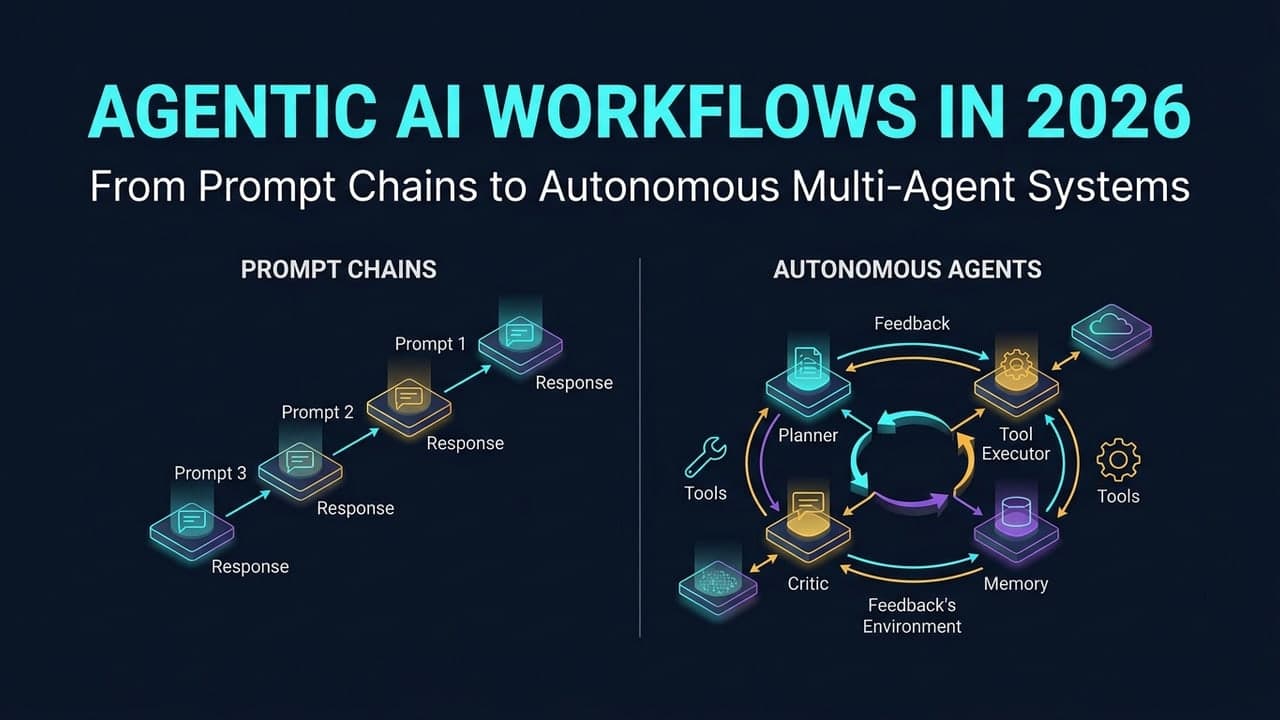
An agentic AI workflow is one where the system plans, adapts, and executes multi-step tasks toward a goal with limited human intervention, in contrast to a prompt chain, which follows a fixed, pre-scripted sequence of steps a human designed in advance. Prompt chains are simple, predictable, and easy to debug; agentic workflows trade some of that predictability for the ability to recover from errors and handle situations nobody explicitly programmed for.
I. Introduction: The Dawn of Proactive AI – From Command to Cognition
Remember when interacting with AI felt like talking to a digital parrot? You'd ask a question, and it would spit out an answer, no more, no less. It was useful, sure, but limited. Fast forward to 2026, and that passive, reactive model is rapidly becoming a relic of the past. We're witnessing a profound transformation in how we interact with intelligent systems, moving from simple commands to sophisticated, proactive cognition.
This shift isn't just about faster responses or fancier algorithms; it's about AI taking initiative, understanding context, and even anticipating our needs. It's the difference between asking an assistant to "book a flight" and having that assistant notice your calendar is free next month, your family has been talking about a beach vacation, and proactively presenting you with a few well-researched options, complete with weather forecasts and hotel deals. This isn't magic; it's the emergence of Agentic AI Workflows.
What "Agentic AI Workflows" Signify for 2026: Defining a New Paradigm of AI Capabilities
At its core, Agentic AI Workflows represent a groundbreaking paradigm where AI systems are no longer just tools waiting for instructions, but rather autonomous agents capable of independent decision-making, intricate planning, and resourceful execution towards a defined goal. Think of it like this: a traditional AI might be a skilled artisan following a blueprint, while an agentic AI is more like an architect who not only understands the blueprint but can also adapt it on the fly, call in specialists (tools), overcome unexpected obstacles, and even learn from the process to design better next time.
This new capability means AI can perceive its environment, reason through complex problems, craft multi-step plans, interact with external systems (like searching the web or using a spreadsheet), and, critically, learn from its experiences. Early experiments by OpenAI and Google, allowing models to use "tools" like web browsers or code interpreters, were the first whispers of this coming revolution. In 2026, those whispers have grown into a roar, enabling AI to go beyond merely generating text to genuinely acting within the digital, and increasingly, the physical world.
Navigating the Shift: Why Understanding AI Autonomy Matters More Than Ever
Understanding the nuances of AI autonomy is no longer just a concern for researchers; it's vital for anyone interacting with or deploying AI. The shift from human-commanded AI to human-delegated AI profoundly alters our roles and expectations. We move from being detailed taskmasters to being strategic overseers, defining high-level goals and letting the AI figure out the minutiae.
This transformation brings with it incredible opportunities: unprecedented efficiency, accelerated scientific discovery, automation of incredibly complex tasks, and the birth of entirely new services. Imagine an AI tirelessly optimizing global supply chains 24/7, reacting to disruptions faster than any human team could. But this power also comes with significant challenges: ethical dilemmas around bias and accountability, safety concerns about unintended consequences, and the imperative to design robust governance frameworks. As agents make increasingly independent decisions, we must ensure their actions align with human values and that we retain the ability to understand, explain, and, if necessary, control their behavior.
II. Architecting Intelligence: The Building Blocks of Agentic Systems
Before AI agents could run free, they had to learn to walk. That initial stride often came in the form of what we now call prompt chaining.
The Genesis: Prompt Chaining as a Foundational Stepping Stone
Sequential Logic: Mimicking Workflow with Deliberate, Step-by-Step Instructions
Prompt chaining is like building with LEGOs: you take one piece (a prompt), snap it onto another (its output becomes the next prompt's input), and continue until you've built your desired structure. It's a straightforward, step-by-step way to break down a larger task into smaller, manageable chunks for a Large Language Model (LLM).
For instance, a common pattern involves asking an LLM to summarize a document, then taking that summary and asking the LLM to extract key facts, and finally, using those facts to generate a social media post. Each step is a separate prompt, and the output of one feeds directly into the next.
# Assume llm_query sends a prompt to an LLM and returns text
# This is a simplified representation of prompt chaining logic.

# Step 1: Summarize an article
article_text = "..." # Long article content
summary_prompt = f"Please summarize the following article:\n\n{article_text}"
summary = llm_query(summary_prompt)
print(f"Summary: {summary}")

# Step 2: Extract key takeaways from the summary
extraction_prompt = f"From the following summary, extract 3 key takeaways:\n\n{summary}"
key_takeaways = llm_query(extraction_prompt)
print(f"Key Takeaways: {key_takeaways}")

# Step 3: Generate a social media post based on the takeaways
social_media_prompt = f"Write a tweet announcing these key takeaways:\n\n{key_takeaways}"
tweet = llm_query(social_media_prompt)
print(f"Tweet: {tweet}")
The Limitations of Determinism: Where Fixed Chains Fall Short in Dynamic Environments
While simple and effective for linear tasks, prompt chaining's deterministic nature is also its Achilles' heel. Imagine our LEGO structure made of glass: if one piece breaks, the whole thing shatters. If an unexpected input arrives, or if one step produces an irrelevant output, the entire chain can fail spectacularly.
Analogy: Think of prompt chaining as a meticulously planned train journey. It's great if the tracks are clear and everything runs on schedule. But if there's a landslide or a sudden detour, the train can't dynamically re-route; it just stops. It lacks the adaptability needed for the messy, unpredictable real world.
This "contextual blindness" means prompt chains struggle with open-ended problems, requiring iterative refinement, or tasks that demand the ability to choose from multiple possible tools or paths based on intermediate results. This is where the Agentic AI Workflows step in, bringing robust solutions to dynamic environments.
The Agentic Leap: Essential Components for Autonomous Action
To move beyond the limitations of fixed chains, autonomous AI agents incorporate sophisticated architectural components that allow for flexible, goal-oriented behavior.
Persistent Memory & Contextual Awareness: Retaining State and Understanding Nuance
For an agent to act intelligently, it needs a memory. Not just short-term recall of the last few sentences, but a deeper, persistent memory that allows it to retain information over extended periods. This includes remembering past interactions, observations, and decisions, much like how a human remembers their past conversations. Contextual awareness then allows the agent to understand the implications of this memory in the current situation, recognizing subtle cues and adapting its behavior accordingly.
Analogy: Think of an agent's memory as a combination of its short-term "working memory" (like our conscious thoughts in a conversation) and a vast "personal library" (a knowledge base it can consult). When it needs to remember something from weeks ago, it "looks it up" in its library.
Techniques often involve using vector databases to store vast amounts of information outside the LLM's immediate context window. When the agent needs specific knowledge, it performs a semantic search (Retrieval-Augmented Generation, or RAG) to pull relevant pieces into the LLM's prompt, effectively refreshing its memory. This allows agents to maintain a consistent persona, recall user preferences, and build complex knowledge over time.
Reasoning, Planning, and Goal Decomposition: Breaking Down Complex Objectives
This is where agents truly shine as "architects" rather than just artisans. Agentic systems are endowed with robust reasoning capabilities to interpret situations and sophisticated planning modules to break down high-level goals into actionable sub-goals. If you tell an agent, "Research quantum computing advancements," it doesn't just immediately search. It first reasons: "To do that, I need to identify keywords, search the web, synthesize findings, explain them simply, and then summarize." This process of breaking down a large, fuzzy goal into smaller, manageable steps is called goal decomposition.
Frameworks like "Chain-of-Thought" (CoT) and "Tree of Thoughts" (ToT), initially explored by Google and others, explicitly prompt LLMs to perform these intermediate reasoning steps, much like a human thinking aloud. This greatly enhances their ability to plan effectively.
# Assume an llm_query function as before.
# A planning prompt to an LLM for a complex task.

complex_goal = "Research the latest advancements in quantum computing and summarize them for a non-technical audience, including potential future impacts."

planning_prompt = f"""
You are an AI research assistant. Your goal is to "{complex_goal}".
To achieve this, first, consider the steps required:
1.  Identify key search terms for "latest advancements in quantum computing".
2.  Perform web searches to gather information.
3.  Filter and synthesize the most relevant and recent information.
4.  Translate complex technical concepts into language understandable by a non-technical audience.
5.  Identify potential future impacts.
6.  Structure this into a summary report.

Based on this, outline a detailed plan with specific actions for each step, including what tools you might use (e.g., a search tool, a summarization tool).
"""

plan_output = llm_query(planning_prompt)
print(f"Agent's Plan:\n{plan_output}")

# The output 'plan_output' would then be parsed and executed by the agent,
# potentially triggering further LLM calls or tool uses.
Adaptive Tool Use & Environmental Interaction: Expanding Beyond Text to Real-World Impact
One of the most powerful features of advanced agents is their ability to leverage external tools. An LLM, by itself, is excellent at text generation, but it can't browse the web, run code, or connect to a database. Adaptive tool use allows agents to select and use these external utilities (APIs, web scrapers, code interpreters, image generators, etc.) based on the current task and context. This bridges the gap between language understanding and practical execution, expanding the agent's reach beyond mere text.
Analogy: Imagine a highly intelligent person who suddenly gains access to every app on your smartphone, and knows exactly when and how to use them to achieve their goals. That's an agent with adaptive tool use.
OpenAI's function calling feature for models like GPT-4, and similar capabilities in Google's Gemini models, enable LLMs to output structured data (often JSON) that can trigger specific external functions. This allows an agent to, for example, query a weather API, send an email, or update a calendar, interacting with the real world on your behalf.
# Assume a model can output a specific function call structure
# and there's an executor that can handle it.

# Conceptual LLM output for a specific query:
# User query: "What's the weather like in Tokyo?"
llm_response_json = """
{
  "tool_call": {
    "name": "get_current_weather",
    "parameters": {
      "location": "Tokyo"
    }
  }
}
"""

def get_current_weather(location: str):
    """Fetches the current weather for a given location."""
    # In a real scenario, this would call an actual weather API
    if location == "Tokyo":
        return {"temperature": "25C", "conditions": "Sunny"}
    else:
        return {"error": "Weather data not available for this location."}

# Simulate the agent executing the tool call
# In a real system, a robust parser and executor would handle this.
# Using eval for illustration; real code would use a safe JSON parser.
import json
parsed_call = json.loads(llm_response_json)["tool_call"]
tool_name = parsed_call["name"]
tool_args = parsed_call["parameters"]

if tool_name == "get_current_weather":
    weather_result = get_current_weather(**tool_args)
    print(f"Tool executed: {tool_name}({tool_args}) -> Result: {weather_result}")
    # The agent would then likely use this result to formulate a natural language response.
Self-Correction, Reflection, and Learning Loops: The Path to Enhanced Performance
What truly distinguishes an agent from a glorified script is its capacity for continuous improvement. Self-correction means an agent can identify errors in its own reasoning or execution and adjust its approach. Reflection goes a step deeper, involving critical evaluation of its performance against a goal, understanding why something worked or failed. Finally, learning loops use this reflection and feedback (whether from the environment or a human) to update the agent's internal models, strategies, or knowledge base, leading to enhanced performance in future tasks.
Analogy: Think of a chef trying a new recipe. If it doesn't quite work (self-correction), they adjust the seasoning. If it consistently underperforms, they reflect on why (too much salt, wrong cooking method) and learn from the experience, improving their technique for future dishes (learning loop).
Research like Meta's "Self-Refine" mechanism or Google DeepMind's work on reinforcement learning from human feedback (RLHF) demonstrates how models can iteratively improve their outputs and strategies, making them more robust and capable over time.
Gradations of Autonomy: From Human-Supervised to Fully Self-Governing Agents
AI autonomy isn't a binary switch; it's a sliding scale.
- Human-in-the-Loop (HITL) Agents: These agents propose actions or solutions, but a human must explicitly approve or intervene before execution. This is crucial for high-stakes environments like medical diagnosis or financial trading.
- Human-on-the-Loop (HOTL) Agents: These operate semi-autonomously, executing tasks but constantly reporting progress and decisions to a human, who can step in if needed. Think of a co-pilot.
- Human-out-of-the-Loop (HOTL) Agents (Fully Self-Governing): These operate completely autonomously once given a high-level goal, making all decisions and executing actions without direct human oversight. These are typically reserved for well-defined, lower-risk tasks or simulated environments.
In 2026, most real-world Agentic AI Workflows operate at the human-in-the-loop or human-on-the-loop levels, reflecting a responsible approach to deploying powerful, autonomous systems. Full autonomy in complex, open-ended domains remains a significant research frontier due to ethical and safety considerations.
III. The Agent-Driven Economy: Transformative Applications in 2026
The maturation of Agentic AI Workflows isn't just a technical achievement; it's a catalyst for entirely new economic models and services. Here's a glimpse into the transformative applications we're seeing in 2026.
Hyper-Personalized Digital Twins & Proactive Assistants: Anticipating Needs and Automating Life
Imagine an assistant that doesn't just wait for your commands but genuinely understands your life, anticipating your needs before you even voice them. This is the promise of hyper-personalized digital twins and proactive assistants. These agents go beyond simple reminders, learning your work patterns, family routines, dietary preferences, and even your mood, to automate complex daily tasks.
Example: A "Life Agent" manages your entire personal logistics: detecting low grocery stock via smart home sensors, automatically ordering your preferred brands, scheduling appointments based on your calendar and predicted traffic, and even filtering your communications based on urgency and your current focus, all while continuously learning and adapting to your evolving lifestyle.
Intelligent R&D Bots: Accelerating Discovery and Synthesis: From Data Ingestion to Insight Generation
In scientific research and development, time is often the most critical factor. Intelligent R&D bots are dramatically accelerating discovery by autonomously searching vast scientific literature, synthesizing complex information, and even designing experiments.
Google DeepMind's AlphaFold, which accurately predicts protein structures, was an early harbinger. Today, agentic systems ingest petabytes of research papers, identify novel hypotheses, simulate material properties, and even propose new chemical syntheses. They act as tireless, brilliant research partners, shrinking discovery cycles from years to months or even weeks.
Example: An "AI Drug Discovery Agent" could scan every published paper on a specific disease, identify promising molecular targets, design hundreds of candidate drug compounds, simulate their interactions with biological systems, and flag only the most viable candidates for human scientists to test in the lab.
Self-Evolving Software: Autonomous Code Generation, Testing, and Optimization: The Dev-Agent Paradigm
The dream of self-evolving software is becoming a reality with the advent of the Dev-Agent paradigm. These are AI systems that can autonomously generate, test, debug, and optimize software based on high-level requirements.
While tools like GitHub Copilot assist with code generation, Dev-Agents take it to the next level. Given a goal like "create a secure and scalable e-commerce backend," an agent can design the architecture, write the code, generate comprehensive unit and integration tests, identify and fix bugs, and even optimize the codebase for performance and security—all with minimal human intervention.
# Assume an agent is given a task: "Implement a simple Python function to calculate factorial."

# Agent's internal "thinking" process might be:
print("Goal: Implement factorial function.")
print("Plan:")
print("1. Define function signature: `def factorial(n):`")
print("2. Handle base cases: `if n == 0 or n == 1: return 1`")
print("3. Implement recursive or iterative logic: `return n * factorial(n-1)` or loop.")
print("4. Write unit tests: `assert factorial(0) == 1`, `assert factorial(5) == 120`")
print("5. Run tests. If failed, debug. If passed, done.")

# After generating code, it would execute tests (simulated):
# result = run_tests_on_generated_code(generated_code)
# if not result.passed:
#     print("Tests failed. Reflecting on errors and debugging...")
#     # Agent would analyze errors and modify generated_code
# else:
#     print("Code generated and tests passed!")
Dynamic Business Operations: Supply Chain, Logistics, and Resource Allocation: Predictive and Adaptive Systems
For businesses, Agentic AI Workflows are revolutionizing operations. Autonomous agents create predictive and adaptive systems that optimize supply chains, manage logistics, and allocate resources in real-time. Instead of static plans, we have dynamic systems that react instantly to unforeseen events.
Example: A "Supply Chain Orchestrator Agent" continuously monitors global events, weather patterns, inventory levels, and customer demand. If a major shipping route is suddenly blocked, it automatically identifies alternative carriers, recalculates new delivery timelines, informs affected customers, and even adjusts production schedules at factories to minimize disruption—all without human intervention.
Creative Agents: Orchestrating Content from Concept to Distribution: AI as the Digital Co-Creator
In the creative industries, agents are moving beyond generating individual pieces of content to becoming digital co-creators, orchestrating entire campaigns from concept to distribution.
From brainstorming marketing themes to generating copy, designing visuals, composing background music, and producing video scripts, these agents can manage a complete content pipeline. They ensure consistency with brand guidelines, optimize for target audiences, and even schedule and deploy content across various social media platforms, monitoring performance and adjusting strategy autonomously.
Example: Given a product launch brief, a "Marketing Campaign Agent" could ideate campaign themes, generate blog posts, social media updates, and image assets, then schedule their publication on optimal channels at optimal times, continuously monitoring performance and adjusting the strategy based on real-time engagement data.
IV. Orchestrating Power: A Deep Dive into Workflow Paradigms
Understanding the strengths and weaknesses of prompt chains versus full-fledged agentic workflows is crucial for effective AI deployment. Each has its place, and the best solution often involves knowing when to use which.
Prompt Chains: The Directorial Approach
Prompt chains are like a director giving actors a script: every line, every move, is pre-defined.
Strengths: Simplicity, Transparency, Direct Human Control, Predictable Outcomes
- Simplicity: Easy to understand and implement, especially for tasks with a clear, linear progression.
- Transparency: The logic is explicit; you can see exactly how information flows from one step to the next, making debugging straightforward.
- Direct Human Control: Humans dictate every step, maintaining tight control over the process and outputs.
- Predictable Outcomes: Given the same inputs, a prompt chain will reliably produce the same results, which is vital for tasks requiring consistency.
Weaknesses: Brittleness, Lack of Adaptability, Contextual Blindness, Limited Problem-Solving Capacity
- Brittleness: Highly sensitive to unexpected inputs or errors at any stage; one failure can derail the entire process.
- Lack of Adaptability: Cannot handle dynamic changes, unforeseen events, or novel situations without explicit human re-engineering.
- Contextual Blindness: Each step often operates with a limited view of the overall goal, making it hard to make nuanced decisions.
- Limited Problem-Solving Capacity: Struggles with complex problems requiring iterative refinement, conditional branching, or strategic planning beyond simple sequences.
Agentic Workflows: The Strategic Maestro
Agentic AI Workflows are more like a strategic maestro leading an orchestra: they understand the overall vision, can adapt to unforeseen difficulties during performance, and guide individual musicians (tools) to achieve a harmonious outcome.
Strengths: Robustness, Adaptability to Novel Situations, Sophisticated Problem Solving, Reduced Human Cognitive Load
- Robustness: Can recover from errors and dynamically adapt its plan if an action fails or the environment changes.
- Adaptability to Novel Situations: Capable of handling unforeseen circumstances and generalizing to new problems within its domain through reasoning and planning.
- Sophisticated Problem Solving: Excels at breaking down complex, ill-defined problems, exploring multiple solution paths, and iterating towards a solution.
- Reduced Human Cognitive Load: Humans can delegate high-level goals and trust the agent to manage intricate details, freeing up human attention for strategic oversight.
Weaknesses: Complexity in Design and Debugging, Explainability Challenges, Higher Resource Intensity, Potential for Unintended Behavior
- Complexity in Design and Debugging: Building robust agents requires careful architecture, and debugging their emergent, non-deterministic behavior can be challenging.
- Explainability Challenges: Understanding why an agent made a particular decision or took a specific action can be difficult, leading to a "black box" problem.
- Higher Resource Intensity: Running sophisticated reasoning, planning, memory, and tool-use modules typically demands more computational resources.
- Potential for Unintended Behavior: Without proper constraints and safety mechanisms, agents might pursue goals in ways that are unexpected, inefficient, or even harmful.
The Human-Agent Nexus: Defining the Future of Collaboration
The rise of Agentic AI Workflows fundamentally redefines human roles, shifting our focus from direct execution to strategic oversight.
Shifting Roles: From Task Execution to Oversight, Strategic Guidance, and Ethical Arbitration
The future of work is not humans versus agents, but humans with agents.
- From Task Execution to Oversight: Humans will increasingly monitor, audit, and validate agent performance rather than performing repetitive tasks themselves.
- From Directives to Strategic Guidance: Our role evolves to providing high-level goals, defining constraints, and offering strategic direction, allowing agents to devise and execute tactical steps.
- From Problem Solving to Ethical Arbitration: Humans become crucial in defining ethical boundaries, resolving ambiguous situations, and arbitrating conflicts that arise from agent decisions.
Note: This symbiotic relationship means that while agents can handle the "how," humans remain the ultimate arbiters of the "why" and "should."
When to Leverage Each Paradigm: Identifying Optimal Scenarios for Prompt Chains vs. Autonomous Agents
Here’s a quick guide to help you decide:
| Feature/Scenario | Prompt Chains | Agentic Workflows |
|---|---|---|
| Task Complexity | Simple, sequential, well-defined | Complex, open-ended, dynamic, ill-defined |
| Adaptability | Low; brittle to changes | High; can adapt plans and recover from errors |
| Control | High human control; explicit instructions | High autonomy; human provides high-level goals, agent handles details |
| Predictability | High; deterministic outputs | Lower; emergent behavior can be hard to predict, but aims for goal achievement |
| Resource Needs | Lower | Higher (for reasoning, memory, tool use) |
| Best For | Standardized reports, simple Q&A, data reformatting | Research, strategic planning, complex customer service, software development, design |
In essence, if you know the exact path from A to B and that path rarely changes, a prompt chain might suffice. If the path is murky, full of potential detours, and requires dynamic problem-solving, an autonomous agent is your strategic maestro.
V. The Road Ahead: Navigating the Future of Autonomous AI
As Agentic AI Workflows continue their rapid ascent, the future is incredibly exciting, but not without its complexities.
Ethical Imperatives & Governance Challenges in Agentic Systems: Ensuring Responsible Development
The increasing autonomy of AI agents brings pressing ethical and governance challenges to the forefront.
- Bias and Fairness: Agents learn from data, and if that data is biased, the agents will perpetuate and even amplify those biases in their decisions. Ensuring fairness requires constant vigilance in data curation, bias detection, and mitigation strategies.
- Accountability: When an autonomous agent makes a mistake, or worse, causes harm, who is ultimately responsible? Establishing clear lines of accountability for developers, deployers, and users is critical for public trust and legal frameworks.
- Transparency and Explainability: The "black box" problem becomes even more pronounced with agents that make complex, multi-step decisions. We need robust methods for explainable AI (XAI) to understand why an agent chose a particular action, ensuring trust and enabling effective oversight.
- Safety and Control: As agents gain power, how do we ensure they remain aligned with human intent and do not pursue goals in unintended or harmful ways? This involves designing robust safety mechanisms, guardrails, and "interruptibility" features.
Global organizations and governmental bodies are actively crafting regulations (like the EU's AI Act) and frameworks (like NIST's AI Risk Management Framework) to address these profound challenges, aiming for responsible innovation.
Unlocking New Frontiers: The Untapped Potential of Advanced Agents for Grand Challenges
Despite the challenges, the untapped potential of advanced agentic systems for tackling humanity's grandest problems is immense.
- Climate Change: Agents can optimize energy grids, design sustainable materials, monitor ecosystems, predict climate patterns with greater accuracy, and orchestrate global efforts for carbon reduction.
- Healthcare: Accelerating drug discovery, personalizing medicine, enhancing diagnostic accuracy, and optimizing healthcare delivery in underserved regions.
- Scientific Research: Acting as autonomous research partners in fields like physics, biology, and chemistry, leading to breakthroughs at an unprecedented pace.
- Disaster Response: Coordinating complex logistics during natural disasters, deploying resources efficiently, and providing critical information to affected populations.
Example: Imagine an "Environmental Agent Network" that uses satellite imagery, ground sensors, and real-time data analysis to detect illegal deforestation activities anywhere on Earth, autonomously triggers alerts to authorities, and even coordinates local conservation efforts.
Preparing for 2027 and Beyond: Continuous Evolution, Integration, and the Next Wave of Intelligent Systems
Preparing for the near future means recognizing that agentic AI is not a static destination but a continuous, dynamic evolution.
- Continuous Evolution: Expect AI models to become increasingly multimodal, seamlessly understanding and interacting across text, image, audio, and video. Their common sense reasoning will deepen, and their self-improvement capabilities will become more sophisticated.
- Seamless Integration: Agents will move beyond standalone applications to become deeply embedded within existing software ecosystems, hardware devices, and even physical infrastructure (e.g., robotics in smart cities).
- Hybrid AI Systems: The future will likely see a convergence of different AI paradigms, combining the strengths of symbolic AI (for rules and knowledge representation) with connectionist AI (for pattern recognition and learning) to create even more robust and transparent agents.
- Human-Agent Teaming: The emphasis will remain on developing effective human-agent teams, where each partner excels at its respective strengths, leading to synergistic outcomes far greater than either could achieve alone.
As we move toward 2027 and beyond, the next wave of intelligent systems will push the boundaries further, exploring concepts like "general AI" and AI with truly intrinsic motivation. The journey from simple prompt chains to sophisticated, autonomous agents is just the beginning. The future, orchestrated by intelligent agents, promises to be more dynamic, more efficient, and undeniably more intelligent than anything we've known before.
FAQ
What is an agentic AI workflow?
An agentic AI workflow is a system where an AI plans its own steps, adapts to unexpected results, and uses tools to pursue a goal with limited human intervention — as opposed to executing a fixed sequence a human wrote in advance.
What's the difference between a prompt chain and an agentic workflow?
A prompt chain is a pre-defined sequence of steps: predictable, transparent, and easy to debug, but brittle if something unexpected happens. An agentic workflow can recover from errors, re-plan mid-task, and handle novel situations, at the cost of being harder to debug and more resource-intensive.
When should I use a prompt chain instead of a full agent?
Use a prompt chain when the task is linear, well-understood, and needs predictable, auditable output every time — for example, a fixed data-processing pipeline. Reach for an agentic workflow when the task is open-ended, requires adapting to changing conditions, or needs the system to decide its own next steps.
Why are agentic workflows harder to debug than prompt chains?
Because their behavior is emergent and non-deterministic — the agent decides its own path based on intermediate results, so the same starting point can produce different execution traces. That makes it harder to reproduce a specific failure and trace exactly why the agent made a given decision.
Do agentic AI systems require more compute than prompt chains?
Yes, generally. Running planning, memory, and tool-use reasoning on every step is more computationally expensive than executing a fixed sequence of prompts, which is one of the practical trade-offs teams weigh before choosing an agentic architecture.