Note on Transparency: This article was generated with the assistance of Artificial Intelligence to provide a comprehensive and up-to-date overview of the discussed topic.
Have you ever found yourself in the déjà vu of an incident? The adrenaline, the frantic troubleshooting, the eventual fix... only for a startlingly similar issue to rear its head a few weeks or months later? It's a frustrating, all-too-common cycle in the fast-paced world of technology. We patch, we prod, we push to restore service, but often, the underlying "why" remains elusive.
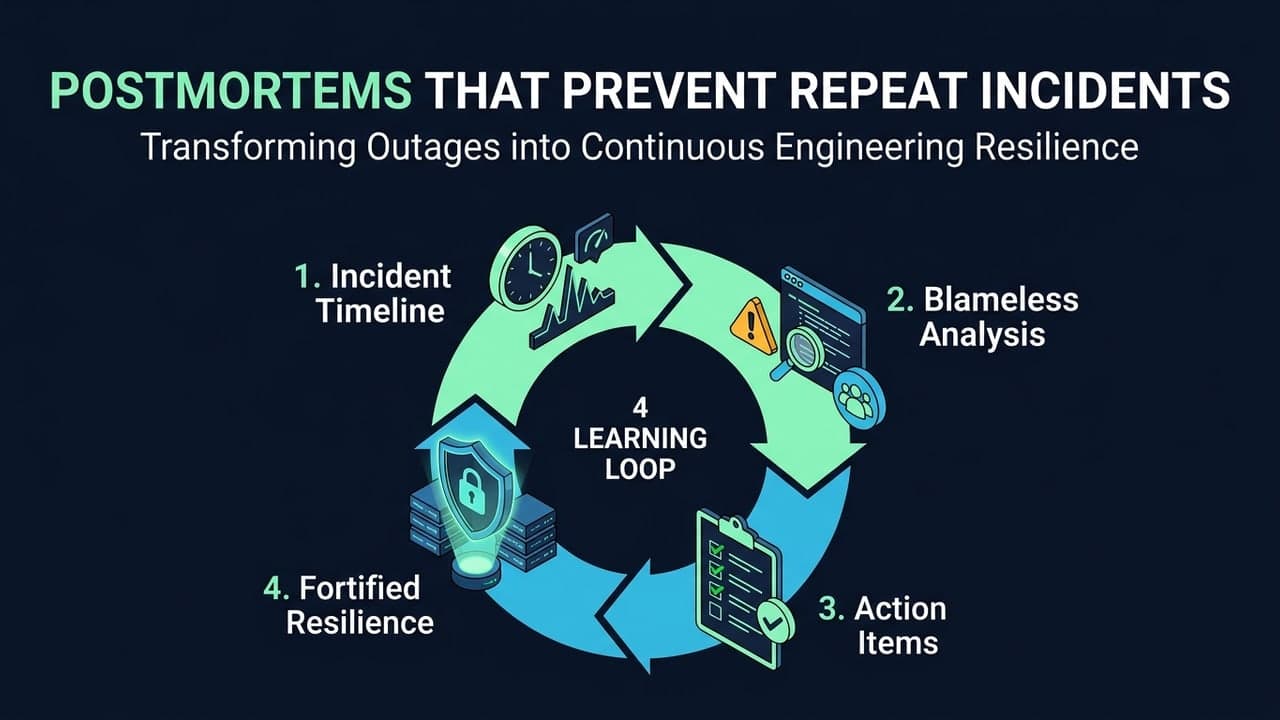
This isn't just inefficient; it's a silent drain on resources, morale, and ultimately, trust. We often focus on fixing the immediate fire, but neglect to mend the structural issues that caused the blaze. This article isn't about just incident response; it's about a fundamental shift in how we learn from failure—a deep dive into effective postmortems that actually prevent repeat incidents.
The Cost of Silence: When Incidents Echo
Imagine your digital infrastructure as a house. When a pipe bursts, you call the plumber, get it fixed, and move on. But if that same pipe keeps bursting in different places, or other pipes in the same wall start leaking, you're not dealing with isolated incidents anymore. You've got a systemic plumbing problem, perhaps even a structural issue with the house's foundation.
Too often, our incident responses are like that quick plumber visit: a temporary patch, a sigh of relief, and then back to business as usual. We celebrate the heroic engineers who restore service, but we rarely pause long enough to truly understand why the pipe burst in the first place, or what latent conditions made it vulnerable. This "illusion of fixed it" is a dangerous trap, creating a false sense of security while operational debt—the accumulated cost of unaddressed systemic issues—piles up, hidden beneath the surface.
This hidden toll isn't just financial. It erodes trust, both among team members and with your users. When incidents reoccur, engineers feel like they're constantly fighting fires, leading to burnout and a pervasive sense of futility. Users, in turn, lose confidence in your service. The promise of effective postmortems is to break this cycle, transforming disruptions into powerful catalysts for learning and resilience.
Beyond Blame and Band-Aids: The Philosophy of True Prevention
The journey towards truly preventative postmortems begins with a profound philosophical shift, moving away from blame and simplistic "root cause" thinking.
The Blameless Imperative: Building Psychological Safety
Think of an incident like a complex medical case. A good doctor doesn't just treat the symptoms; they investigate the patient's history, lifestyle, and underlying conditions. They don't blame the patient for getting sick; they seek to understand the illness. Similarly, in technology, a truly blameless imperative is foundational.
Google SRE Principle: "Punishing people for making mistakes is counterproductive... it discourages people from participating in postmortems, incentivizes concealing mistakes, and creates an environment of fear."
When an incident occurs, our natural human tendency is often to look for a culprit. This is where two cognitive traps, hindsight bias (the "I knew it all along" feeling after an event) and fundamental attribution error (attributing failures to individual character flaws rather than situational factors), can derail our learning.
An effective postmortem environment cultivates psychological safety, where team members feel safe to speak up, admit mistakes, and share information openly without fear of punishment or public shaming. This trust is crucial because the "who" is almost always less important than the "what" and the "why." By focusing on systemic factors rather than individual shortcomings, we unlock deeper insights and create a culture where learning thrives.
From Root Cause Fallacy to Systemic Understanding
In the early days of computing, when systems were simpler, the concept of a "root cause" might have held more weight. But today's distributed systems are incredibly complex, with countless interconnected services, microservices, and dependencies. Pinpointing a single "root cause" is often like trying to find the single raindrop that caused a flood.
"The Myth of the Single Point Failure is a dangerous oversimplification. Incidents rarely have one root cause, but rather a confluence of contributing factors." — John Allspaw & Paul Hammond, pioneers of Blameless Postmortems
Instead, effective postmortems embrace complexity. We focus on identifying contributing factors—a network of technical issues, process gaps, communication breakdowns, and even environmental pressures that align in an unforeseen way. This involves tracing causal chains, understanding how different elements interacted to lead to the incident. It's not about finding the one problem, but understanding the intricate dance of many smaller ones.
Learning as a Strategic Asset
When incidents are treated as valuable data points, postmortems become a strategic investment in resilience. We shift from a reactive mode of constant firefighting to a proactive stance of system hardening. Each incident reveals a vulnerability, an opportunity to improve architecture, refine processes, or invest in preventative measures. This builds long-term reliability and adaptability.
Cultivating a learning culture is paramount here. It's an organizational imperative, where feedback is valued, mistakes are seen as opportunities, and knowledge sharing is encouraged from the top down. Leadership must champion blamelessness and allocate resources for implementing post-incident actions, signaling that learning is a core part of the business strategy.
Dissecting Disaster: Crafting an Actionable Postmortem Process
A truly effective postmortem isn't just a meeting; it's a structured process designed to extract maximum learning from an incident.
Preparation: Gathering the Echoes of the Incident
Before any discussion begins, a thorough investigation needs to happen. This is like collecting forensic evidence at a scene.
-
Data Collection: This is the bedrock. We gather logs (system, application, audit), metrics (CPU, memory, latency, error rates from monitoring systems), and observability data (traces, spans, detailed telemetry from distributed tracing systems). These pieces of data help us reconstruct the factual timeline. Crucially, we also collect communications—chat transcripts, email threads, incident call recordings—to understand human interactions and decision-making under pressure.
# Example: Conceptual API interaction to fetch incident logs for timeline reconstruction # Using a hypothetical PagerDuty-like API client # This might return data like: # { # "type": "annotate", # "created_at": "2023-10-26T10:00:00Z", # "summary": "Analyst noted high CPU on service X.", # "agent": { ... } # }, # { # "type": "acknowledge", # "created_at": "2023-10-26T10:05:00Z", # "summary": "Incident acknowledged by engineer Y.", # "agent": { ... } # } -
Stakeholder Identification and Pre-Briefings: Who needs to be in the room? Engineers directly involved, incident commanders, relevant product owners, and sometimes customer success. Pre-briefings ensure everyone understands the blameless intent and has a preliminary grasp of the timeline, allowing for more productive discussion during the main session.
Facilitation: Guiding the Narrative, Unlocking Insights
The postmortem meeting itself requires skilled neutral leadership. The facilitator's job is to steer the conversation away from blame and speculation, ensuring all voices are heard and the focus remains on objective facts and systemic issues.
A critical step is chronological reconstruction. Collaboratively, the team builds a shared understanding of "what happened when," plotting key events, actions, observations, and decisions in order. This shared narrative forms the factual basis for deeper analysis.
Analysis: Mapping the Interconnections, Not Just the Symptoms
This is where we go beyond the superficial. While the "5 Whys" can be a starting point, complex incidents demand more sophisticated techniques.
- Structured Investigation Techniques: We might use advanced timeline analysis to pinpoint critical decision points, or models like SCARF (Status, Certainty, Autonomy, Relatedness, Fairness) to understand human behavior under stress. Safety-II principles encourage us to also examine why things usually go right, not just why they sometimes go wrong. Barrier analysis helps identify which defenses (technical, procedural, human) failed to prevent or mitigate the incident.
- Identifying Latent Conditions and Systemic Weaknesses: This is the goldmine. We seek out latent conditions—hidden flaws like outdated documentation, insufficient training, technical debt, or organizational silos—that contributed to the incident but weren't immediately obvious. Think of James Reason's "Swiss Cheese Model": incidents occur when the holes in multiple layers of defense (the latent conditions) align. Uncovering these allows us to address the root vulnerabilities, not just the symptoms.
Actionability: Engineering Resilience Through Concrete Commitments
A postmortem is useless without clear, actionable outcomes. This is where insights translate into tangible change.
-
Defining SMART Actions: Each action item must be Specific, Measurable, Achievable, Relevant, and Time-bound. This ensures clarity and accountability.
// Example: Structure for a SMART action item action_item = { "id": "PM-2023-10-26-001", "description": "Implement automated database connection pool monitoring with alerts for exhaustion.", "owner": "database_team_lead", "priority": "High", "status": "Open", "due_date": "2023-11-30", "measure_of_success": "Alerts successfully configured and firing in staging, then production, for connection pool utilization > 80% for 5 minutes.", "related_incident": "INC-2023-10-25-001", "contributing_factor_addressed": "Lack of visibility into database connection pool exhaustion prior to incident." } -
Ownership, Deadlines, and Follow-Up: Every action item needs a clear owner and a firm deadline. A robust follow-up mechanism—tracking tools, regular reviews in team meetings, or dedicated "postmortem review" sessions—closes the accountability loop. This ensures that learnings are actually implemented, cementing the value of effective postmortems.
Iterating the Process: Postmortems for Postmortems
The process itself isn't static. Just as our systems evolve, so too should our approach to learning from incidents. We must regularly review the effectiveness of our postmortem process: Are we identifying the right actions? Are they being completed? Are we actually seeing a reduction in similar incidents? Gather feedback, integrate it, and adapt your methodologies to continuously improve how your organization learns.
Real-World Resilience: Lessons from the Leaders of Learning
The principles of effective postmortems are not just theoretical; they are battle-tested strategies employed by industry leaders.
Case Studies: Transforming Incidents into Innovation
- Netflix: Famously champions Chaos Engineering, intentionally injecting failures into production to find weaknesses before they cause customer-impacting incidents. Their culture embraces failure as a learning opportunity, leading to highly resilient systems.
- Etsy: Was an early pioneer of blameless postmortems, emphasizing psychological safety and public transparency in their incident reports. This cultural shift helped them move from reactive to proactive reliability.
- Google SRE: Integrates incident management into its core philosophy, using Error Budgets (a defined tolerance for unreliability) to balance innovation with stability. Their systematic incident review process is mandatory, blameless, and rigorously tracked.
- Healthcare and Aviation: These High-Reliability Organizations (HROs) have long-standing safety cultures that prioritize rigorous, blameless incident investigations. Practices like flight data recorders and mandatory reporting are designed to identify systemic flaws and prevent recurrence, offering invaluable lessons for tech.
Tools and Technologies That Empower Deep Dives
Modern tech stacks offer powerful allies in conducting effective postmortems:
-
Incident Management Platforms: Tools like PagerDuty or Opsgenie streamline incident response and often integrate with communication platforms to automatically generate timelines, capturing who did what, when.
# Conceptual Python interaction to fetch metrics for postmortem analysis # Assuming a monitoring_api client like for Datadog or Prometheus # This might return data like: # { # "metric": "system.cpu.usage", # "points": [ # {"timestamp": 1678886400, "value": 0.5}, # {"timestamp": 1678886460, "value": 0.55}, # {"timestamp": 1678886520, "value": 0.9}, # Spike during incident # ] # } -
Observability Stacks and Data Visualization: Comprehensive logging, metrics, and tracing platforms (e.g., Datadog, Prometheus, Grafana, Jaeger) combined with powerful visualization tools are indispensable. They allow teams to correlate data across services, identify anomalies, and visualize how failures propagate through complex distributed systems.
Beyond Tech: Applying Preventative Postmortems
The principles of blameless inquiry, systemic thinking, and actionability are universally applicable. Effective postmortems can be used in:
- Product Development: Analyzing failed product launches or features that missed expectations.
- Project Management: Understanding why projects went over budget or scope.
- Organizational Change: Investigating why change initiatives faced resistance or failed to deliver.
Learning from failure is a fundamental human endeavor, applicable far beyond the server room.
The Future of Failure: From Reaction to Proactive Resilience Engineering
Our understanding of how to learn from failure has evolved significantly.
Comparing Methodologies: Evolution in Incident Learning
| Feature | Traditional Incident Reviews | Blameless Postmortems | Resilience Engineering |
|---|---|---|---|
| Focus | Immediate fix, individual accountability | Systemic causes, organizational learning | Adaptive capacity, how systems succeed |
| Goal | Prevent recurrence by fixing problem | Prevent recurrence by improving system | Proactively enhance system's ability to adapt |
| Culture | Blame-prone, fear of mistakes | Psychological safety, transparency | Continuous learning, understanding performance |
| Output | "Root cause," quick fixes | Multiple contributing factors, SMART actions | Deep system understanding, adaptive strategies |
Resilience Engineering represents the cutting edge. It moves beyond merely preventing failures to proactively understanding how systems succeed despite complexity. It views incidents not as failures to be avoided at all costs, but as crucial data points to understand system boundaries and strengthen adaptive capacity.
Organizational Architectures for Learning
The structure of an organization directly impacts its ability to learn. While some favor centralized incident response teams for consistency and expertise, others prefer distributed ownership, empowering development teams with deep domain knowledge. Many organizations adopt a hybrid approach, with a central team providing guidance and tools, and individual teams owning their service's postmortems.
Crucially, management and leadership play a pivotal role. They must model blamelessness, allocate resources for learning, promote transparency, and celebrate efforts that contribute to system resilience. Without this top-down commitment, even the best postmortem processes will falter.
The Horizon: AI-Assisted Analysis and Predictive Postmortems
The future of incident analysis will be increasingly powered by AI and machine learning.
-
Leveraging Machine Learning: AI algorithms can analyze vast quantities of historical incident data, logs, and metrics to identify recurring patterns, common failure modes, and latent conditions that human analysts might miss. They can correlate anomalies across different parts of a complex system (e.g., a database spike with a deployment) to pinpoint potential causal relationships far faster.
# Conceptual example: Using a machine learning model for anomaly detection # In a real scenario, this would involve much more complex data pipelines and models. # from sklearn.ensemble import IsolationForest # import numpy as np # data = np.array([0.01, 0.02, 0.01, 0.5, 0.03, 0.01, 0.02]).reshape(-1, 1) # model = IsolationForest(contamination=0.1) # model.fit(data) # anomalies = model.predict(data) # print(f"Anomaly detection result: {anomalies}") # Output might be: Anomaly detection result: [ 1 1 1 -1 1 1 1] (where -1 indicates an anomaly) -
Anticipatory Learning and Preventative System Design: The ultimate goal is to move towards "predictive postmortems" or anticipatory learning. By continuously analyzing system telemetry and leveraging AI, organizations aim to identify early warning signs of impending failures, simulate failure scenarios in new designs, and move towards truly preventative system design—building resilience in from the ground up, rather than just reacting to outages.
The Unending Journey: Cultivating a Culture of Continuous Improvement
Effective postmortems are more than just incident reports; they are a cornerstone of operational excellence. They represent a fundamental shift from fearing failure to embracing it as an invaluable teacher. By fostering psychological safety, adopting systemic thinking, and committing to continuous improvement, organizations can transform incidents from liabilities into powerful assets for growth and resilience.
In a world of increasing complexity and unpredictability, incidents are inevitable. The organizations that thrive will be those that view every disruption not as an endpoint, but as a crucial waypoint on an unending journey of learning and adaptation. By embedding the principles of preventative postmortems deep into their DNA, companies can build truly adaptive, resilient systems and cultures that are capable of navigating—and even thriving amidst—an unpredictable future. This continuous pursuit of improvement, fueled by genuine learning from every incident, is the ultimate competitive advantage.
A Framework for Triaging Production Issues: Severity, Blast Radius, and What to Check First