Note on Transparency: This article was generated with the assistance of Artificial Intelligence to provide a comprehensive and up-to-date overview of the discussed topic.
The journey to fully automated content creation for your blog is less about finding a magic button and more about designing a smart, interconnected system. This guide will walk you through building such a system, focusing on narrative flow and practical implementation over rigid, generic steps. We'll explore the core architectural choices, the tools that bring it to life, and how to maintain quality and ethical standards in an evolving AI landscape.
The Promise of Automated Publishing: Why Build an AI Content Pipeline?
Imagine your blog as a bustling content factory. If you're currently the sole worker, hand-crafting every article, image, and social snippet, you know the immense effort involved. The allure of an Automated AI Content Pipeline is simple yet profound: it transforms that factory floor, bringing in a team of intelligent assistants to handle the repetitive, time-consuming tasks. This isn't just about speed; it's about shifting your focus from the grind of content production to the art of content strategy and true creative oversight.
This kind of automation significantly reduces the time and effort traditionally required to produce high-quality digital content. Instead of spending hours brainstorming topics, researching keywords, drafting, and editing, an intelligent pipeline can manage much of this heavy lifting. Tools are emerging that leverage sophisticated AI algorithms to create engaging blog posts, marketing copy, and product descriptions with a fraction of the manual input, allowing for scaling content creation without a proportional increase in human resources.
By automating these foundational content tasks, you unlock a strategic advantage: freeing up your valuable time for higher-level creative and strategic work. This means more time for in-depth audience engagement, innovative brand building, complex research that AI can assist but not fully replace, and fine-tuning your overall content vision. This guide, then, is your blueprint for constructing this intelligent content engine, moving beyond generic steps to focus on practical implementation and a narrative flow that empowers you to re-envision your entire content strategy.
Dissecting the Intelligent Content Engine: Architectural Blueprint
Building an effective Automated AI Content Pipeline requires thinking of it like a digital organism. It needs a brain, a nervous system, and a robust skeleton, all working in harmony. This architectural blueprint will demystify the distinct stages and the components that power them.
From Concept to Curation: Understanding the Stages
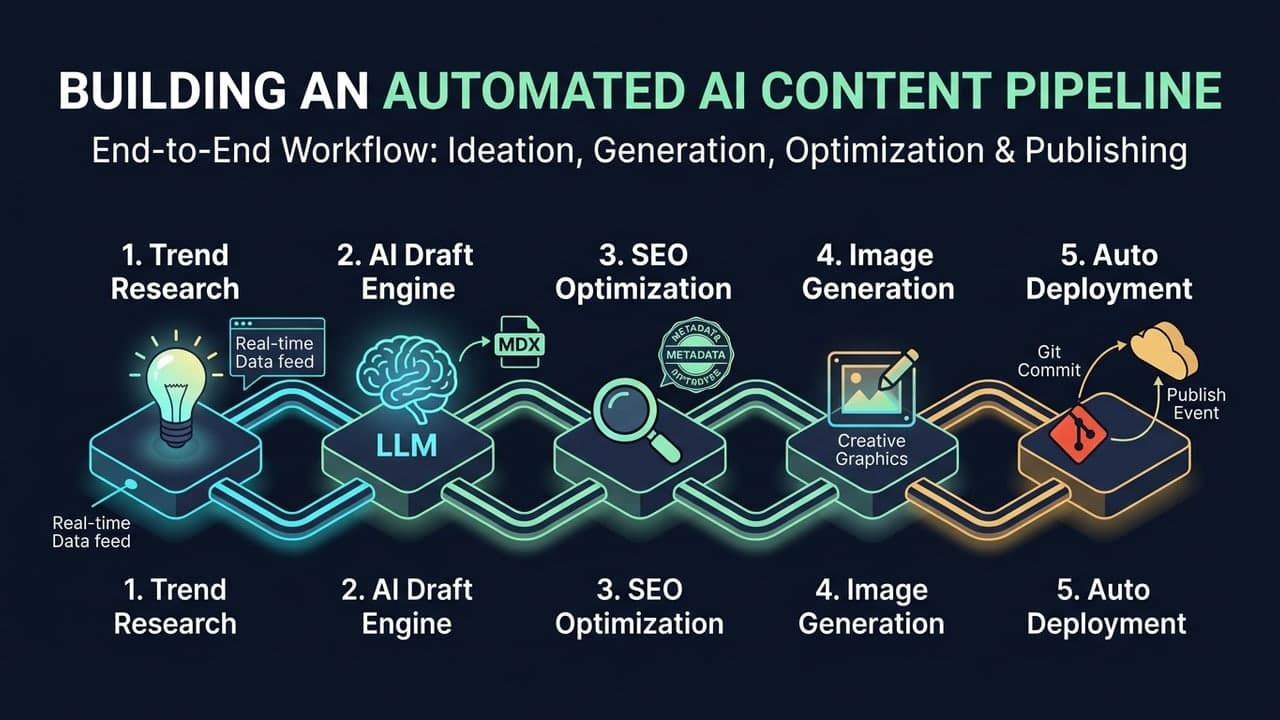
The journey of content within an AI pipeline typically flows through distinct stages, much like a well-organized assembly line. These stages ensure a structured approach from initial thought to final publication:
- Ideation: This is where content ideas are born. AI can assist by generating topic clusters, keyword suggestions, and initial research outlines based on trends or specific prompts.
- Generation: The AI models take over to draft the initial content, whether it's a blog post, a social media update, or a product description.
- Optimization: Here, the generated content is refined. This might involve SEO enhancements, adjusting for tone and style, or incorporating specific data points.
- Review: A critical human-in-the-loop stage where the content is fact-checked, edited for accuracy and brand voice, and polished. This includes quality scoring and editorial pattern review.
- Publishing: The final, approved content is then automatically pushed to your chosen Content Management System (CMS) or platform.
This comprehensive, multi-pass approach, often involving several feedback loops before delivery, ensures quality and relevance at every step.
The Brain of the Operation: Core AI Models and Their Roles
At the heart of your pipeline are various AI models, each with a specialized function:
- Generative LLMs (Large Language Models): These are the workhorses for text generation, capable of producing human-like prose. Models from OpenAI (like GPT) and Anthropic (like Claude) are prime examples, fundamental for drafting everything from articles to marketing copy. They're constantly being evaluated for their capabilities in understanding context and generating coherent responses.
- Embedding Models: These models convert text into numerical representations called embeddings. Think of them as giving each piece of text a unique digital fingerprint that captures its meaning. This is crucial for tasks like semantic search (finding content based on meaning, not just keywords), content recommendations, and identifying related topics, especially important in Retrieval Augmented Generation (RAG) systems where AI retrieves relevant information before generating responses.
- Image Generators: AI tools capable of creating visuals from text prompts, such as DALL-E or Midjourney, can be integrated to enrich textual content, providing relevant and engaging images automatically.
- SEO Analyzers: These tools, often AI-powered, assess generated content for search engine optimization. They perform numerous research-backed checks across various scoring categories, querying different AI engines to verify citations and automatically generate JSON-LD schema (structured data for search engines),
robots.txtrules, and analyze for Answer Engine Optimization (AEO) and Generative Engine Optimization (GEO) — essentially optimizing content for how AI models process and answer queries.
Connecting the Dots: Essential Components
For these intelligent brains to communicate and act, you need a robust digital nervous system made of interconnected components:
- APIs (Application Programming Interfaces): These are like digital translators, allowing different software systems to talk to each other. For example, AI models expose their functionalities through APIs, letting your automation platform integrate them into custom workflows. You might also use a SERP API (Search Engine Results Page API) to programmatically access search engine results for real-time SEO analysis.
- Webhooks: These are automated messages sent from apps when a specific event occurs. Think of them as silent alarms that trigger the next step in your automation workflow—for instance, notifying your system when a new draft is ready for review.
- Databases: These are crucial for storing and managing your content, its metadata, and the current state of your workflow. They ensure data persistence and organization throughout the pipeline, essential for long-running AI agents and content versioning. No-code databases like Baserow can even be self-hosted for greater control.
- Automation Platforms: These are the conductors of your digital orchestra, orchestrating the entire workflow by linking various tools and models together, managing the sequence of operations, and handling error reporting.
Thinking Architecturally: Designing for Modularity, Scalability, and Maintainability
Building a robust Automated AI Content Pipeline isn't just about piecing tools together; it requires thoughtful architectural design:
- Modularity: Design your system with independent, self-contained components. This is like building with LEGOs—each piece has a specific function, and you can swap them out or upgrade them without affecting the entire structure. This flexibility is vital in a rapidly evolving AI landscape.
- Scalability: Your architecture must be able to handle increasing content demands and data volumes. As your blog grows, your pipeline should effortlessly scale to produce more content without bottlenecks. This might involve leveraging cloud-based components or designing for distributed processing.
- Maintainability: The system should be easy to understand, debug, and evolve over time. Using frameworks that manage AI prompts, models, and parameters as version-controlled configurations, or tools that promote clear workflow definitions, greatly aids in making your pipeline manageable and future-proof.
Forging Your Automated Workflow: Tools, Technologies, and Practical Build-Out
With the architectural blueprint in hand, it's time to gather your tools and start building. The choices you make here will define the capabilities, flexibility, and cost of your Automated AI Content Pipeline.
Choosing Your Generative Core: Proprietary vs. Open Source LLMs
The foundational decision for any AI content pipeline is which Large Language Model will be its "brain" for content generation. You generally have two paths:
- Proprietary LLMs (e.g., OpenAI GPT, Anthropic Claude):
These are cutting-edge models offered as services by tech giants.
- Strengths: Often boast superior performance, broader general knowledge, and robust API integrations. The "OpenAI-compatible" API has become a de facto standard, simplifying integration into many existing tools.
- Considerations: Cost models are typically based on token limits (chunks of text) and usage, which can include cached input and write costs. While powerful, they can be less transparent about their training data and internal workings. Solutions often route through unified APIs that can manage costs and offer auto-fallback across providers.
- Open-Source LLMs (e.g., Llama, Falcon, Mistral):
These models can be self-hosted on your own infrastructure.
- Strengths: Offer unparalleled control and flexibility. You can custom fine-tune these models on your specific datasets, allowing them to perfectly mimic your brand voice and niche expertise. Crucially, they provide complete data control and privacy, as your data never leaves your environment.
- Considerations: Requires more technical expertise and computational resources to set up and maintain. Performance might lag behind proprietary models for general tasks unless extensively fine-tuned.
| Feature | Proprietary LLMs (OpenAI GPT, Anthropic Claude) | Open-Source LLMs (Llama, Falcon, Mistral) |
|---|---|---|
| Performance | Often state-of-the-art for general tasks | Varies; can be exceptional with custom fine-tuning |
| Control | Less control over internals, data handling | Full control over model, data, and infrastructure |
| Customization | Limited fine-tuning options via API | Extensive custom fine-tuning possible |
| Cost | Usage-based (token limits), can scale with volume | Upfront hardware/hosting, lower per-token cost after setup |
| Privacy | Data handled by third-party providers | Data remains in your environment |
| Ease of Use | Easier API integration, managed infrastructure | Requires more technical setup and maintenance |
The strategic consideration here boils down to a trade-off: cloud-based power and ease of use versus local flexibility, privacy, and deep customization.
The Orchestration Layer: Automating the Flow
Once you have your generative core, you need an orchestration layer to act as the central nervous system, automating the flow of content and connecting all the components.
- No-Code Champions: Zapier & Make (Integromat): These platforms are fantastic for quick integration and workflow automation using a drag-and-drop interface. Ideal for solopreneurs or small teams without coding expertise, they connect thousands of apps and services with minimal effort.
- Low-Code Powerhouses: n8n & Activepieces: These self-hostable, open-source alternatives offer greater customization and data privacy while still simplifying integration compared to full custom scripting. They provide a visual workflow builder but allow for custom code snippets when needed, striking a balance between ease of use and power.
- Custom Scripting with Python: For ultimate control, bespoke integrations and complex logic can be built using Python. This allows for highly tailored workflows and the integration of unique functionalities not available off-the-shelf, making it the choice for maximum flexibility and performance.
Content Management System Integration
Publishing directly to your blog platform is the final, crucial step. Many AI content automation tools are designed with robust integrations for popular CMS platforms like WordPress, Ghost, Webflow, or even custom platforms via their APIs. This allows your automated content to be pushed seamlessly from the pipeline to your blog, often including formatting, categorization, and even scheduling.
Adding Strategic Layers
To truly elevate your Automated AI Content Pipeline, integrate specialized tools that ensure content quality and strategic advantage:
- SEO Tools: Services like SurferSEO or Clearscope offer APIs that can analyze your AI-generated content against top-ranking articles for specific keywords. Integrating these allows for real-time optimization, ensuring your content is discoverable and ranks well by automatically suggesting improvements or even implementing them.
- Plagiarism Checkers: Automated checks for originality are vital to avoid legal issues and maintain credibility. Integrating a plagiarism API into your review stage ensures every piece of content meets originality standards.
- Tone Analyzers: To maintain a consistent brand voice, integrate AI-powered tone analyzers. These tools can assess the emotional and stylistic qualities of your content, flagging deviations and helping ensure every article sounds authentically "you."
Real-World Manifestations: Diverse Pipelines in Action
The beauty of an Automated AI Content Pipeline is its adaptability. It's not a one-size-fits-all solution but a customizable engine that can be tailored to various needs and scales. Let's look at a few practical examples:
- The Solopreneur's Evergreen Engine: A simple setup can be a game-changer for an individual blogger. Imagine feeding a single prompt like "Generate 10 blog post ideas about sustainable living for digital nomads, then write a 1500-word article on the best eco-friendly travel gear." The pipeline automatically brainstorms topics, selects one, generates a detailed outline, drafts the article, and then schedules it for human review before publishing to WordPress. This transforms content creation from a monumental task into a streamlined, hands-off process for evergreen content.
- The Niche Authority Builder: For businesses aiming to dominate specific keywords, a more complex pipeline can craft targeted, SEO-optimized content series. This might involve AI performing deep keyword research, generating multiple articles around a central theme, creating AI-generated visuals (like custom infographics or header images) to accompany each post, and even suggesting internal linking strategies to build topical authority. Each article is optimized for AEO and GEO, ensuring it performs well in search engines and AI answer engines.
- The E-commerce Content Dynamo: For online stores with large inventories, an AI content pipeline can automate product descriptions, category summaries, and support articles across thousands of products. A trigger (e.g., a new product added to the database) could initiate the AI to pull product specs, generate a unique, engaging description, create an FAQ snippet, and push it directly to the product page on your e-commerce platform. This frees up significant resources, allowing human writers to focus on high-value marketing campaigns.
- Beyond Text: Incorporating AI-Generated Visuals and Audio Snippets: Modern pipelines aren't limited to text. Tools are emerging that connect AI agents to image and video generation services, allowing for the automatic creation of compelling visuals that accompany articles. Imagine an AI generating a blog post, then simultaneously creating a unique header image, a social media graphic, and even a short audio summary snippet for podcast promotion—all automatically integrated into your publishing process.
Beyond Automation: Quality, Ethics, and the Evolving Human-AI Partnership
While automation offers immense benefits, the human element remains indispensable for ensuring quality, navigating ethical considerations, and adapting to the rapid evolution of AI. A truly effective Automated AI Content Pipeline isn't about replacing humans but augmenting them.
The Indispensable Human Loop: Crafting Effective Review and Editing Stages
The biggest misconception about automation is that it removes the need for human oversight. In reality, a "human-in-the-loop" approach is critical for high-quality content:
- Full Automation vs. Human-in-the-Loop: While full automation offers unparalleled speed and cost efficiency, it often comes at the expense of nuance, brand voice, and factual accuracy. A human-in-the-loop model, where critical review and approval gates are implemented at various stages, strikes a balance between efficiency and quality. Think of it like a master chef: the AI might prepare the ingredients and even cook the dish, but the human chef still tastes, seasons, and plates, ensuring it meets their high standards.
- Establishing Quality Gates: Implement machine-enforced quality gates at various stages. This includes automated fact-checking against trusted sources, ensuring brand voice consistency through stylistic analysis, and stylistic refinement to meet your editorial guidelines. Prompt Engineering—the art of crafting precise and clear instructions to guide AI models for better outputs—is a proactive form of quality control, ensuring the AI understands your expectations from the start.
- Prompt Engineering as Quality Control: The effectiveness of AI-generated content hinges heavily on the quality of your prompts. Learning to guide AI models with specific instructions, desired tones, formats, and constraints is paramount. A well-engineered prompt can significantly reduce the need for extensive post-generation editing, acting as a powerful first line of defense for quality.
Navigating the Ethical Landscape of AI Content
As AI becomes more sophisticated, the ethical considerations surrounding its use in content creation become paramount:
- Transparency and Disclosure: It's crucial to establish clear guidelines on when and how to inform your audience about AI-generated content. Maintaining trust and credibility often involves transparently disclosing the role of AI in your content production process.
- Bias Mitigation: AI models can, unfortunately, inherit biases present in their training data. Addressing these inherent biases and their potential impact on your content is vital to ensure fairness, accuracy, and inclusivity. Regularly reviewing content for biased language or perspectives is a necessary step.
- Copyright, Plagiarism, and Originality: Ensuring that your automated output remains unique, original, and legally sound requires careful consideration. This involves understanding the legal landscape around AI-generated content, verifying the originality of outputs, and adhering to copyright laws to avoid inadvertent plagiarism.
Future-Proofing Your Pipeline
The AI landscape is evolving at an exhilarating pace. Future-proofing your pipeline involves designing it to be adaptable:
- Adapting to rapid AI advancements: Regularly update your models, leverage new tools, and integrate emerging AI capabilities. Modular architecture makes this significantly easier.
- Evolving content demands: Be agile enough to adjust your pipeline to new content formats, audience preferences, and platform requirements. The ability to quickly reconfigure workflows will keep your blog relevant.
The Future of Your Blog: A Supercharged Creative Nexus
Building an Automated AI Content Pipeline is more than just a tech project; it's a strategic overhaul of your content operations. We've journeyed through understanding its promise, dissecting its architecture, choosing the right tools, seeing it in action, and critically examining the human role in maintaining quality and ethics.
The transformative power of a well-designed pipeline is undeniable. It transforms content creation from a laborious task into a streamlined, efficient, and scalable process. From initial ideation and topic generation to content optimization, review, and final publication, an intelligent content engine re-envisions your entire content strategy. It allows you to produce more, faster, and with greater consistency, all while freeing you to focus on the high-level strategic goals and creative innovations that only a human can provide.
Embracing the journey of intelligent automation is about building a system that not only scales your content but also enhances its quality and strategic impact. Your next steps involve taking this blueprint, experimenting with the tools, and meticulously crafting the workflows that will pave the way for a truly supercharged creative nexus for your blog. The future of content is here, and it's automated, intelligent, and deeply collaborative.